
If you’re looking at Plausible alternatives, the reason is usually on the Plausible plan page.
Starter covers one site, funnels and custom properties start on Business at $39 a month for 100,000 pageviews, and custom events count toward that same limit.
Below are eight tools, each matched to a reason for leaving, with prices at 100,000 monthly pageviews on monthly billing, taken from each vendor’s own page on November 12, 2026.
Why people look for Plausible alternatives
I like Plausible. It’s still the dashboard I hand to clients who have never opened analytics. I’ve moved several of them off GA4 with the 30-minute migration I wrote up, and my full Plausible review covers what it does well.
The complaints I hear are about Plausible’s plans. They come in five kinds.
Site limits: Starter covers one site, Growth up to three, and Business up to ten, with anything past ten on a custom Enterprise plan.
Agencies hit this first. So does anyone with a few side projects.
Funnels and custom properties: both live on Business with user journeys and the Stats API, which at 100,000 pageviews means $39 a month instead of $19 on Starter.
Events share the allowance: the Plausible docs say your tier is based on the total number of pageviews and custom events across all the sites in a team, and that includes outbound clicks, file downloads, form submissions, and 404 tracking.
Does that matter for a blog with one contact form? Barely.
For a site that tracks every download, it decides your tier. Run 90,000 pageviews plus 15,000 tracked downloads for two months in a row, and Plausible asks you to move up to the 200k tier. Ignore that for a week and your dashboards lock. Stats keep collecting in the background.
No free plan: you get a 30-day trial, and Community Edition is free to self-host, but the Plausible comparison page says it leaves out funnels, user journeys, and ecommerce revenue goals.
No replays or heatmaps: Plausible doesn’t sell them on any plan. For most content sites, that’s the right call.
One warning if events are your main complaint. Of the hosted plans below, Statable, Fathom, Pirsch, Umami, Rybbit, and Matomo Cloud all count custom events toward the allowance as well, so switching for this reason alone mostly moves the problem. Simple Analytics bills by “data points,” and I couldn’t find a plain rule for events there. If you track a lot of events, a self-hosted install or GoatCounter is the real way out.
What five sites with funnels cost at 100,000 pageviews
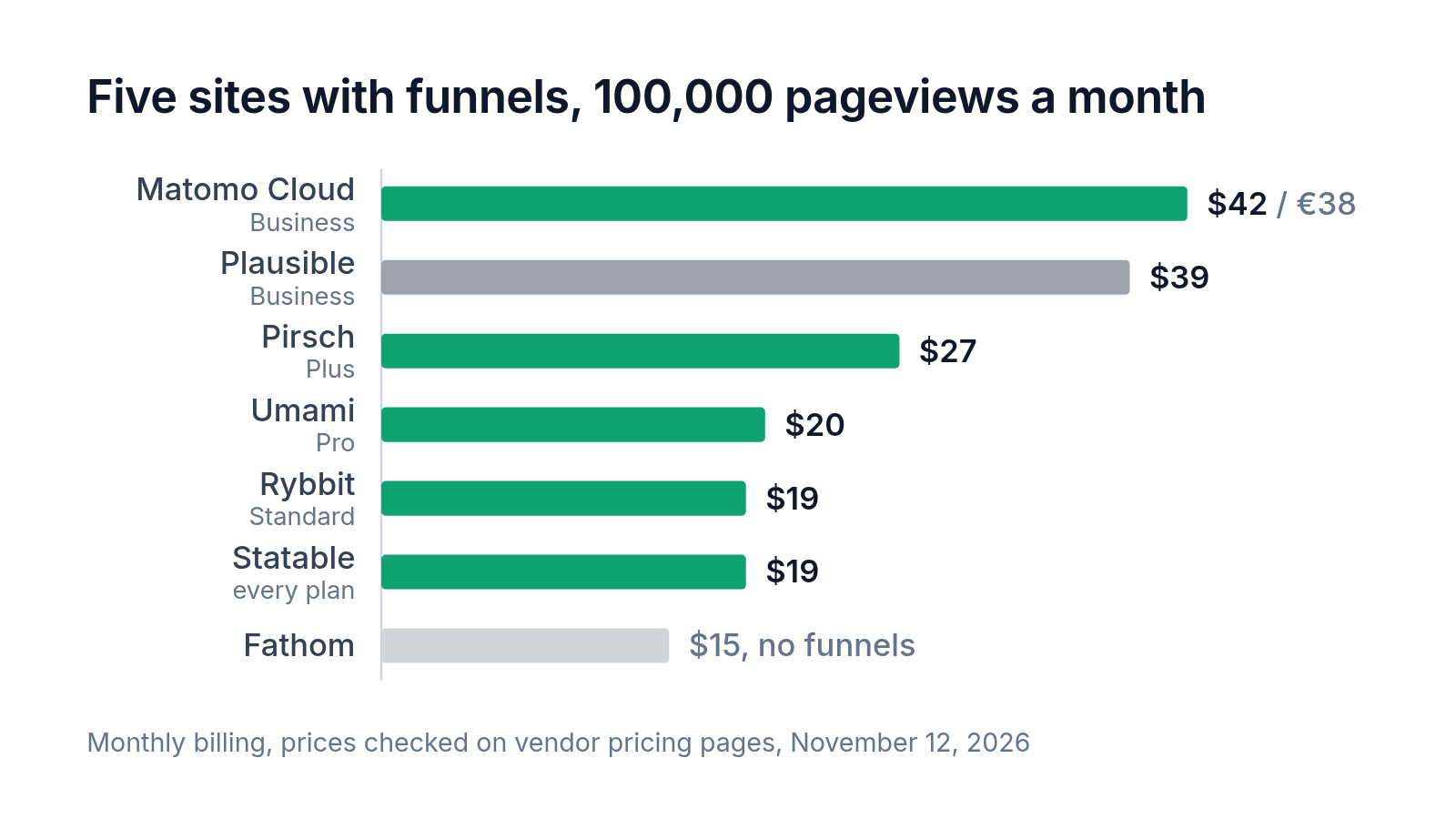
On November 12, 2026, I priced one setup on every vendor’s pricing page: five sites, 100,000 pageviews a month across all of them, monthly billing, and funnels included in the plan.
Here’s what each would charge:
- Statable: $19. Funnels and unlimited sites are on every plan.
- Rybbit: $19 on Standard, which has funnels and stops at five sites.
- Umami: $20 on Pro. The free Hobby plan covers one site.
- Pirsch: $27 on Plus, its plan with funnels.
- Plausible: $39 on Business, its first plan with funnels.
- Matomo Cloud: $42, or €38 if you’re billed in euros.
- Fathom: $15, but funnels aren’t on its feature list.
I left out Simple Analytics, which shows funnels on its features page but not on its pricing page, and GoatCounter, which is free.
So what happens when you add a site?
Add a sixth and Rybbit moves you to Pro at $39. Go past 20 and Umami’s next plan is Business at $200. Past ten, Plausible needs a custom Enterprise quote.
Statable’s price moves only when your traffic does.
My call: if you need one Plausible alternative that handles several sites with funnels, look at the plans where neither a new site nor a new funnel changes the bill. Here that’s Statable at $19, Pirsch Plus at $27, Rybbit Pro at $39, and Umami Business at $200, which is why Statable comes first below.
The eight tools
Each tool answers at least one of those five reasons.
Statable
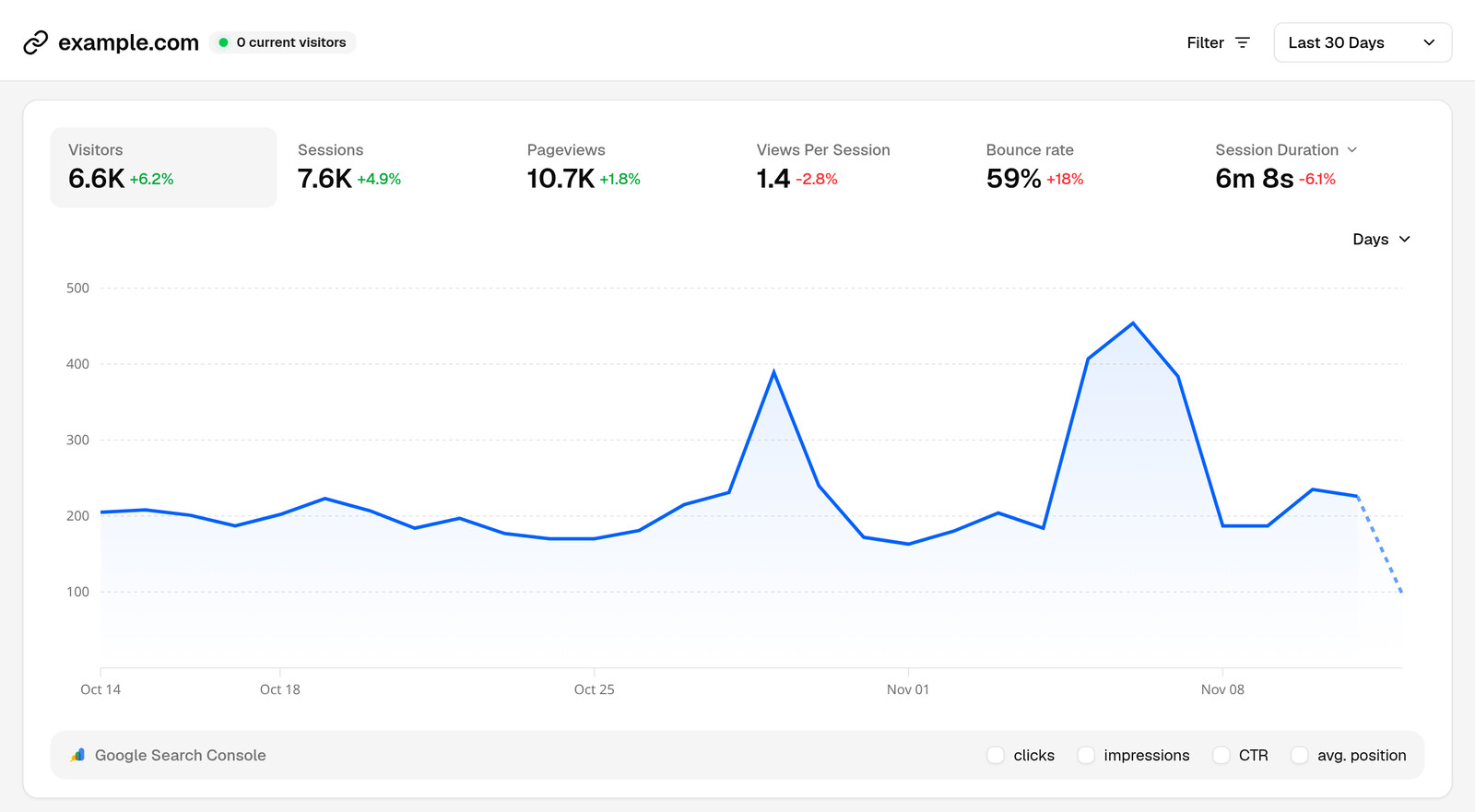
Statable is the first one I’d check if you run several sites or want funnels without moving up a plan. Every paid plan has every feature and unlimited websites. Only the traffic allowance varies, so adding a client site doesn’t change the bill unless total traffic crosses the next tier.
- Funnels, goals, custom events, and custom properties come on every tier, starting at $9 for 10,000 events.
- Your GA4 history imports through a read-only Google sign-in, as it does at several tools below.
- The WordPress plugin draws your stats inside wp-admin, and four widgets (live users, top countries, a map, and a 3D globe) embed on your own pages.
- An MCP server lets Claude, ChatGPT, or Cursor read your numbers and set up goals or funnels. It can’t delete the analytics.
- Data sits on servers in the Netherlands, and the pricing page lists forever retention.
At 100,000 events it’s $19 a month on monthly billing, the same as Plausible Starter, which covers one site and no funnels.
The full tier table runs up to $169 for 10 million events.
Weak spots: the allowance counts pageviews plus custom events, as at Plausible. You can’t import Plausible history. There’s no self-hosting and no session replay.
When I wouldn’t use it: one site, no funnels, and no complaints, because Plausible Starter costs the same and you’d gain nothing. The profile on how Statable’s plans and setup work goes deeper.
Fathom
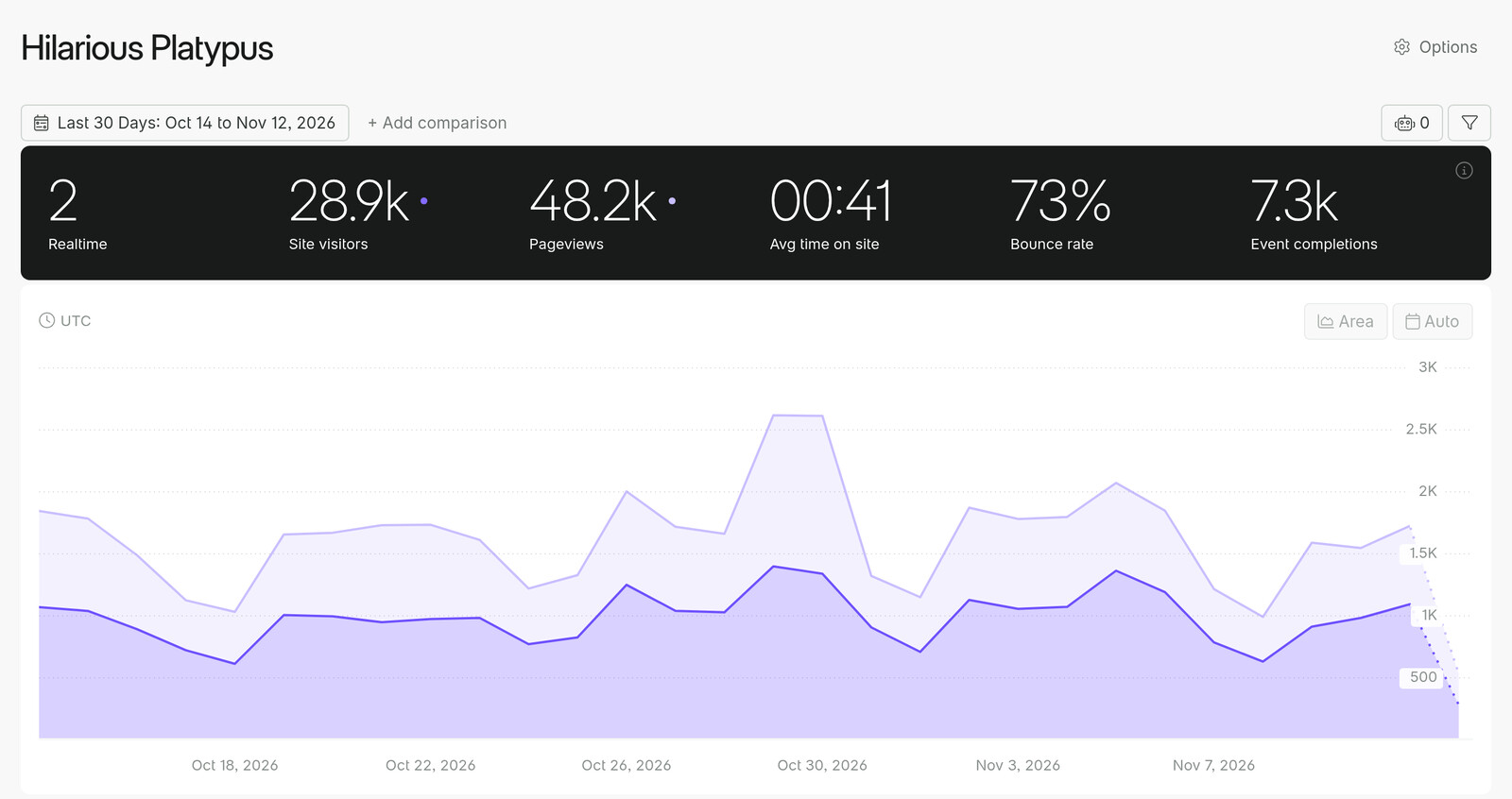
Fathom suits someone with a lot of sites who doesn’t need funnels, since every plan includes 50 sites and more come in packs of 50 for $10 a month.
- $15 a month at 100,000 pageviews, with the same features on every plan.
- GA4 import and a Search Console connection.
- Email reports can bundle several sites into one message, and you can share dashboards publicly or behind a password.
- If you stay well over your limit, Fathom emails you about a bigger plan and keeps collecting.
Weak spot: there’s no free plan. The 7-day trial needs a card, and custom events count toward your pageview allowance.
When I wouldn’t use it: if funnels were the reason you left Plausible. The plan details are in the Fathom notes, and Fathom vs Plausible puts the two side by side.
Umami
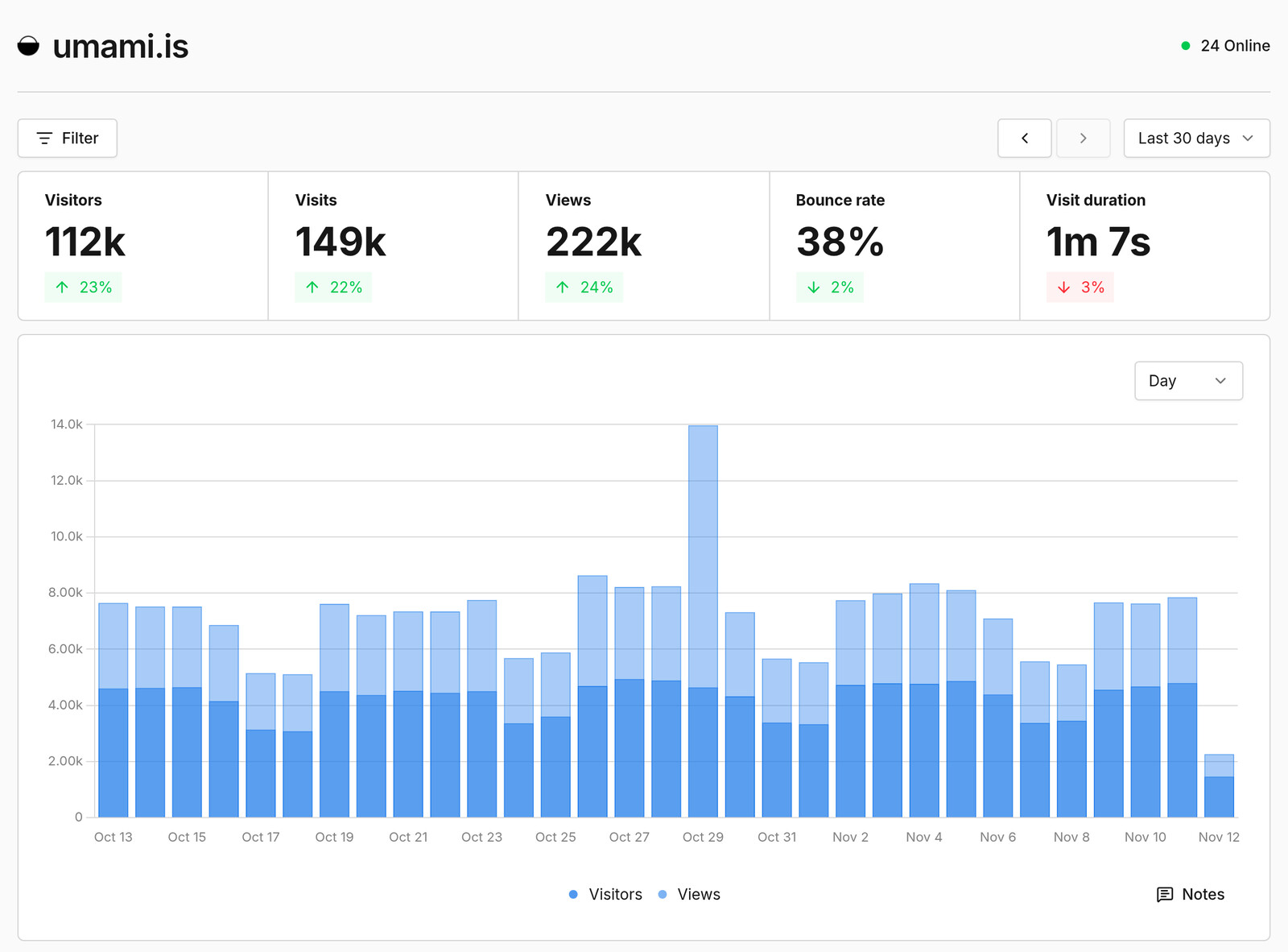
Umami is where I send people who want a free plan or their own server and still want funnels.
- Hobby is $0 for 100,000 events, one website, and six months of history. Funnels, journeys, and retention reports are included even there.
- Pro is $20 a month for 1 million events, up to 20 websites, two years of history, and API and MCP access.
- It’s open source, so you can run it on your own server.
- Extra events on Pro are billed at $0.00003 each.
You’d pay $0 for one site and $20 for up to 20.
Weak spot: replays and heatmaps start on Business at $200, and the allowance counts every event, pageviews included.
When I wouldn’t use it: past 20 sites on the cloud, where the next plan costs ten times as much. The head-to-head is in Plausible vs Umami, and the Umami profile covers self-hosting.
Simple Analytics
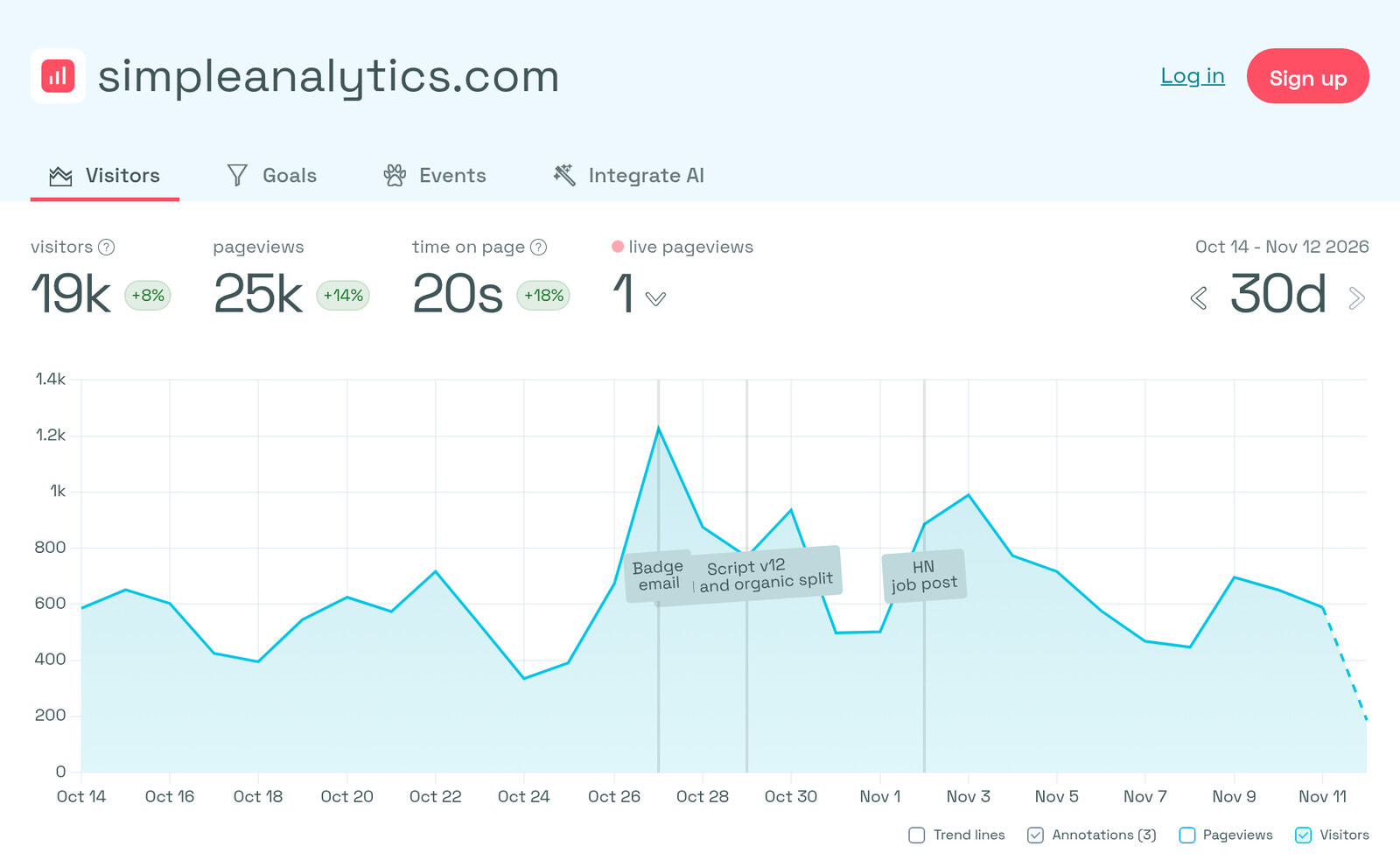
Simple Analytics fits teams whose real blocker is a privacy review. By its own description, it creates no visitor identifiers at all.
- One self-serve plan at $20 a month for 100,000 pageviews, billed by data points averaged over recent months.
- A free plan for up to five websites that keeps one month of history and requires a badge.
- GA4 import, an AI assistant, and an MCP server.
- Hosting in the EU.
Weak spot: the $20 covers one user and each extra seat adds $20 a month. With no identifier, it also can’t spot a repeat visit within the same day, which Plausible can.
When I wouldn’t use it: for a five-person team that all needs logins, which comes to $100 a month, or for anyone who wants to self-host. See the Plausible and Simple Analytics comparison and its profile page for the rest.
Pirsch
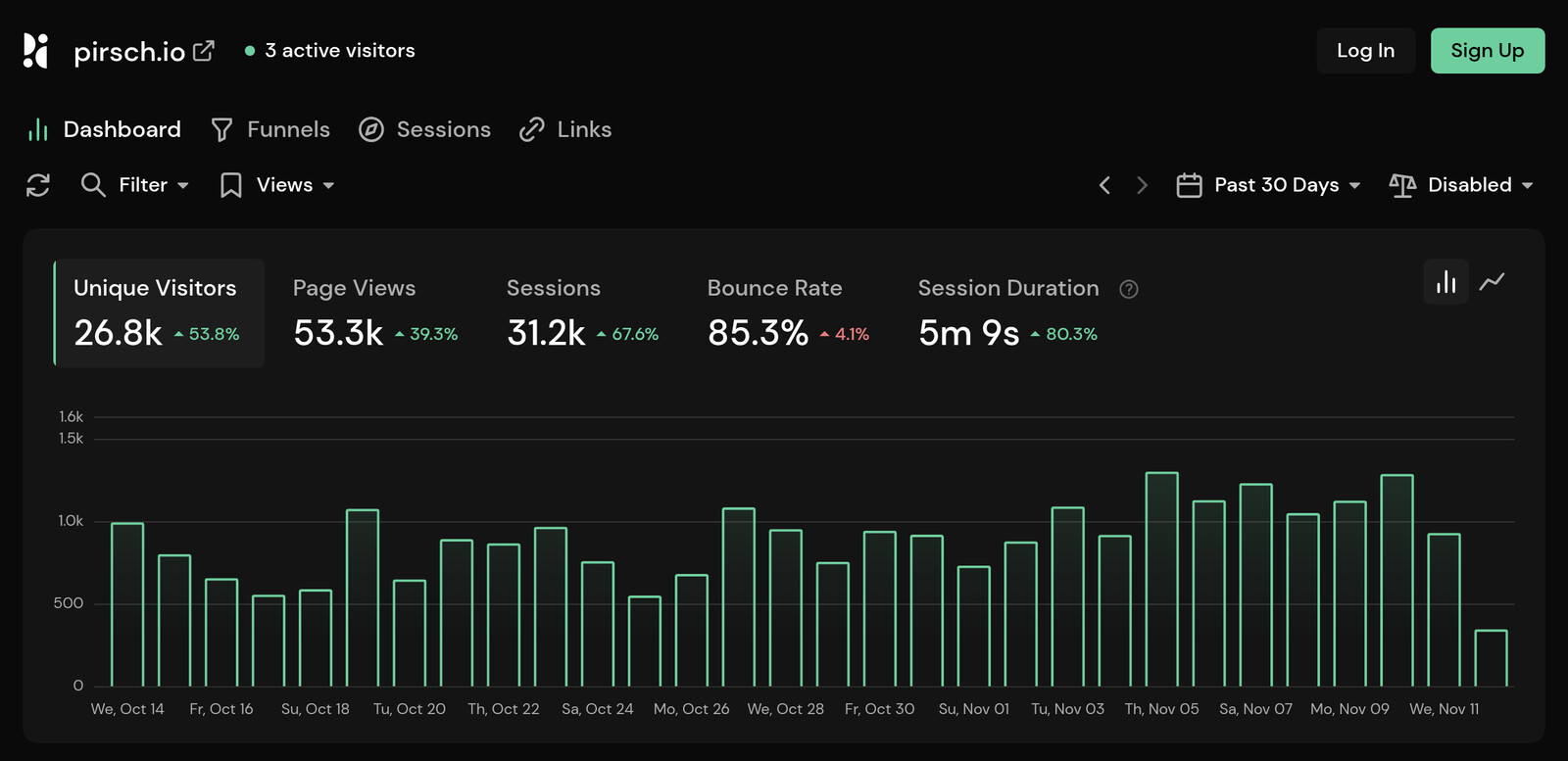
Pirsch is for people who want a lot of sites for little money and can add funnels later.
- Standard is $12 a month at 100,000 pageviews, with 50 websites, unlimited members, and unlimited data retention.
- Funnels, A/B testing, and segmentation are on Plus, $27 at the same traffic, which also lifts the site cap.
- It imports history from Google Analytics, Fathom, and Plausible. The Plausible import works from CSV files.
- A URL shortener comes built in.
Weak spot: custom events count toward the page view limit, plus 10% of the events Pirsch uses to extend sessions.
When I wouldn’t use it: if you need self-hosting, which Pirsch offers only on Enterprise.
Details are in Pirsch vs Plausible and on the Pirsch page.
Rybbit
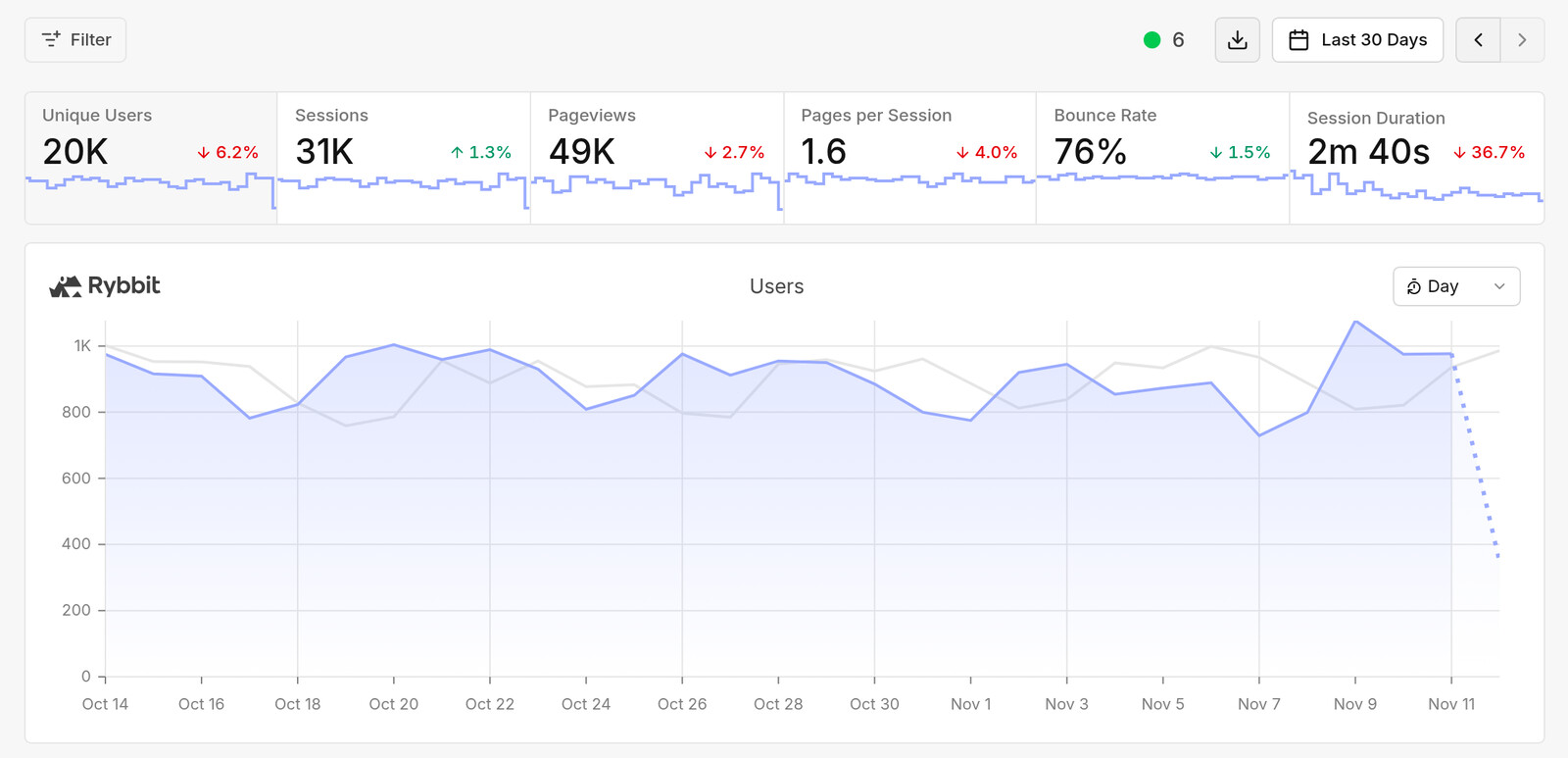
Rybbit is for people who left Plausible wanting more: funnels, journeys, retention, and web vitals.
- Standard is $19 a month at 100,000 pageviews, with up to five websites, three team members, and three years of data.
- Pro is $39 with unlimited websites and members, session replays, and five years of data.
- Annual billing takes four months off, so the page shows $13 and $26 by default.
- The code is open source, and self-hosting is free.
Weak spot: per Rybbit’s billing docs, an organization over its monthly event limit stops collecting until next month or an upgrade. Pageviews, custom events, and web vitals all count toward that limit. What does that mean on launch day? A spike can stop your stats for the rest of the month unless you upgrade.
When I wouldn’t use it: on a site with sudden spikes, unless someone watches the usage meter. The Rybbit profile has setup notes.
Matomo
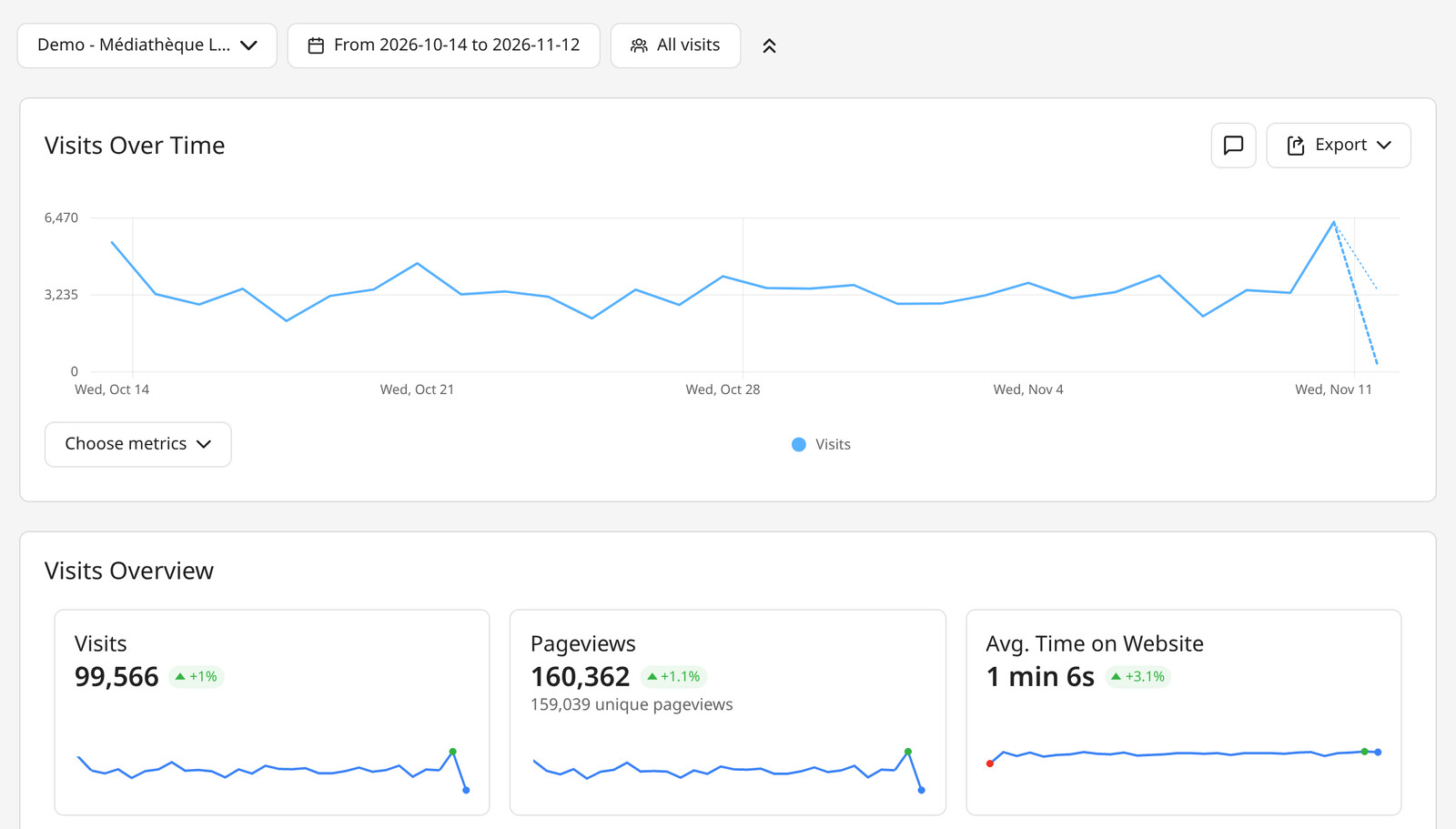
Matomo is for teams that want GA4-level depth without Google. It’s the heaviest tool here, on purpose.
- Cloud Business is $42 a month at 100,000 hits on monthly billing, or €38 if you’re billed in euros. Events count as hits.
- It covers 30 websites, funnels, A/B testing, a GA importer, and 3,000 heatmap pageviews and 300 session recordings a month.
- Cloud data is stored in Europe. Raw data is kept 24 months and reports forever.
- The On-Premise Community edition is free to self-host.
Weak spot: the free self-hosted edition has no funnels or heatmaps, which come in paid bundles starting with Team at $330 a month. Matomo also uses cookies by default, so a cookieless setup is a setting you switch on.
When I wouldn’t use it: for a brochure site with a contact form, where it’s more tool than the job needs. The Matomo profile compares Cloud and On-Premise.
GoatCounter
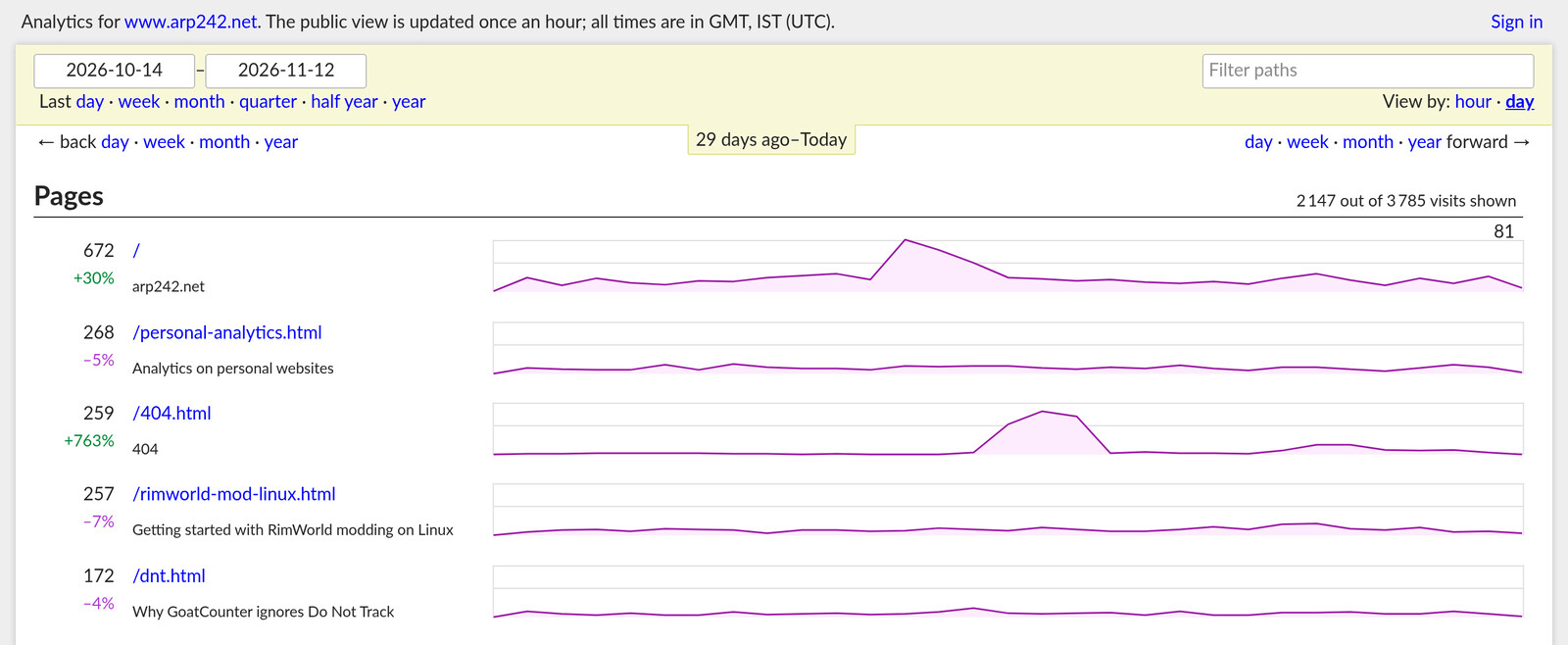
GoatCounter is for personal sites and small projects that want a counter and no bill.
- The hosted service is free for “reasonable public usage” and runs on donations through GitHub Sponsors.
- It’s open source and self-hostable.
- The script adds about 3.5 KB, and you can swap it for a no-JavaScript tracking pixel or a log-file import.
- It counts unique visits without cookies.
At this traffic it costs $0.
Weak spot: it’s basic by design, with pages, referrers, browsers, locations, screen sizes, and campaigns as the main reports. With no paid plan, there’s no support contract either.
When I wouldn’t use it: on a client’s business site, where I’d want a paid service with support behind it. The GoatCounter profile has install notes.
All eight side by side
Monthly prices before tax, with Plausible as the last row.
| Tool | Price at 100k | Self-host | Free plan | Stands out for |
|---|---|---|---|---|
| Statable | $19 | No | .edu, GitHub Pages, and GitLab Pages sites that show a widget | Every feature and unlimited sites on every plan |
| Fathom | $15 | No | No, 7-day trial | 50 sites on every plan |
| Umami | $0 for one site, $20 for up to 20 | Yes | Yes, one site | Funnels and journeys even on the free plan |
| Simple Analytics | $20 for one user | No | Yes, five sites, one month of data | No visitor identifiers |
| Pirsch | $12, or $27 with funnels | Enterprise only | No | 50 sites and unlimited retention on Standard |
| Rybbit | $19 | Yes | No, 7-day trial | Replays on Pro, funnels from the start |
| Matomo | $42 or €38 on Cloud | Yes | Self-hosted only | Heatmaps, recordings, and A/B tests |
| GoatCounter | $0 | Yes | Yes | No-JavaScript pixel and log import |
| Plausible | $19, $29, or $39 | Yes, Community Edition | No | Starter is one site, Business is ten |
Which one fits your reason
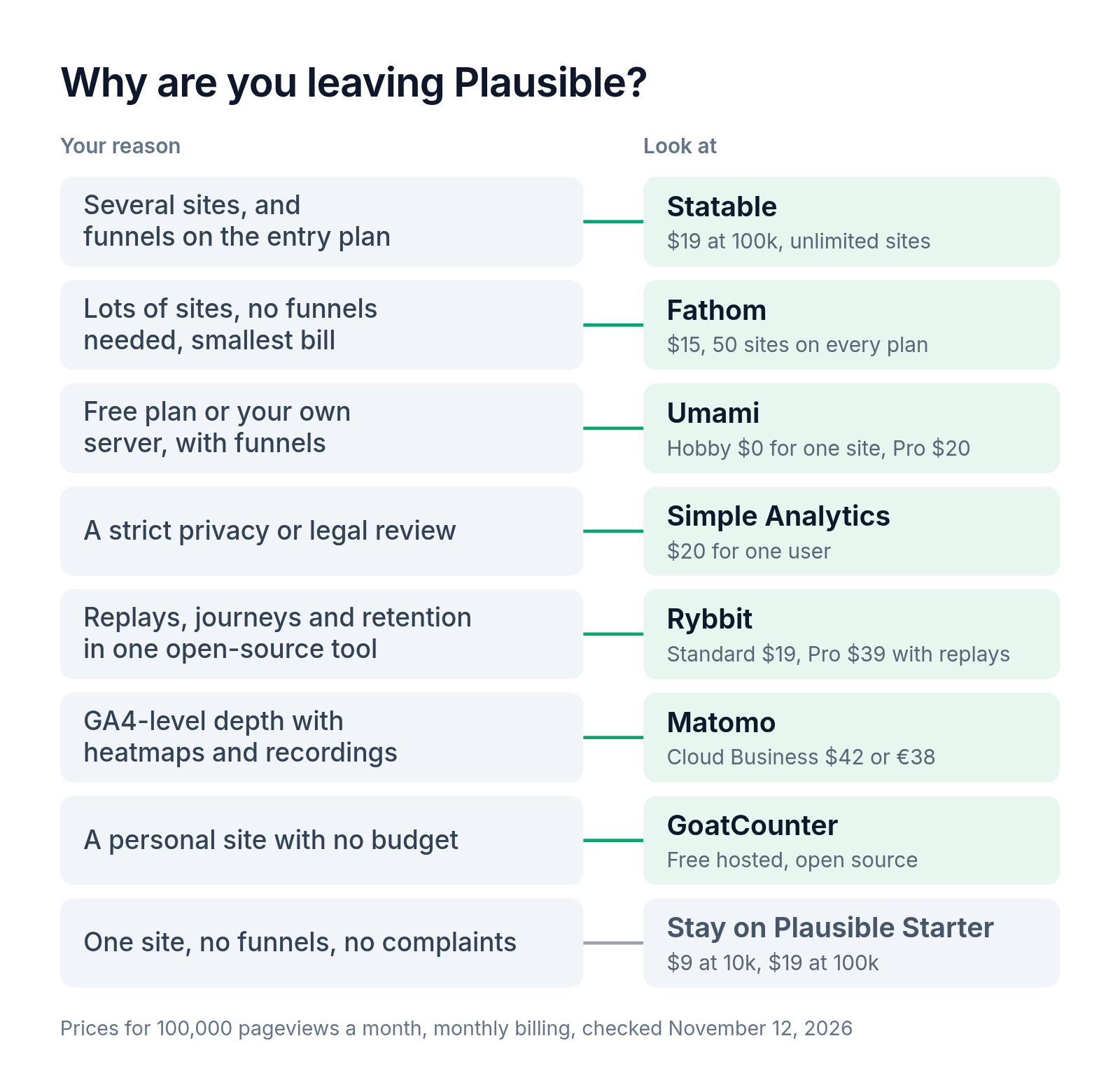
- Several sites and funnels on the entry plan: Statable.
- Lots of sites, no funnels, smallest bill: Fathom or Pirsch Standard.
- A free plan or your own server, with funnels: Umami.
- A strict privacy review: Simple Analytics.
- Replays, journeys, and retention in one open-source tool: Rybbit.
- GA4-level depth with heatmaps: Matomo.
- A personal site with no budget: GoatCounter.
One site and no funnels? Stay on Plausible Starter.
For everything else, pick from the list above and run it next to Plausible for a month, then cancel Plausible once the two sets of numbers stop surprising you.
How I picked these eight
I started from the five reasons above and kept tools whose published plans answer at least one of them. Every price, limit, and feature here comes from the vendor’s own pricing page or docs, read the same day as the price test above. Product suites like PostHog and Mixpanel answer a different question, so I left them out. My wider list of Google Analytics alternatives covers more names.
Plausible pricing and plans: common questions
Is Plausible Analytics free?
The hosted service isn’t. You get a 30-day trial, then plans start at $9 a month for one site and 10,000 pageviews. Community Edition is free if you run your own server.
How much does Plausible cost?
At 10,000 monthly pageviews, Starter is $9, Growth $14, and Business $19. At 100,000 it’s $19, $29, and $39. Yearly billing takes two months off, and VAT is added at checkout where it applies.
What’s a free alternative to Plausible?
Umami’s Hobby plan is free for one site and 100,000 events, with six months of history. GoatCounter’s hosted service is free for reasonable public use. If you’d rather self-host, Umami, Rybbit, Matomo, and GoatCounter are all open source.
Can you self-host Plausible?
Yes. Community Edition is free under the AGPL license, and you handle the server, upgrades, and backups yourself. Support comes from the community, and new releases land about twice a year.