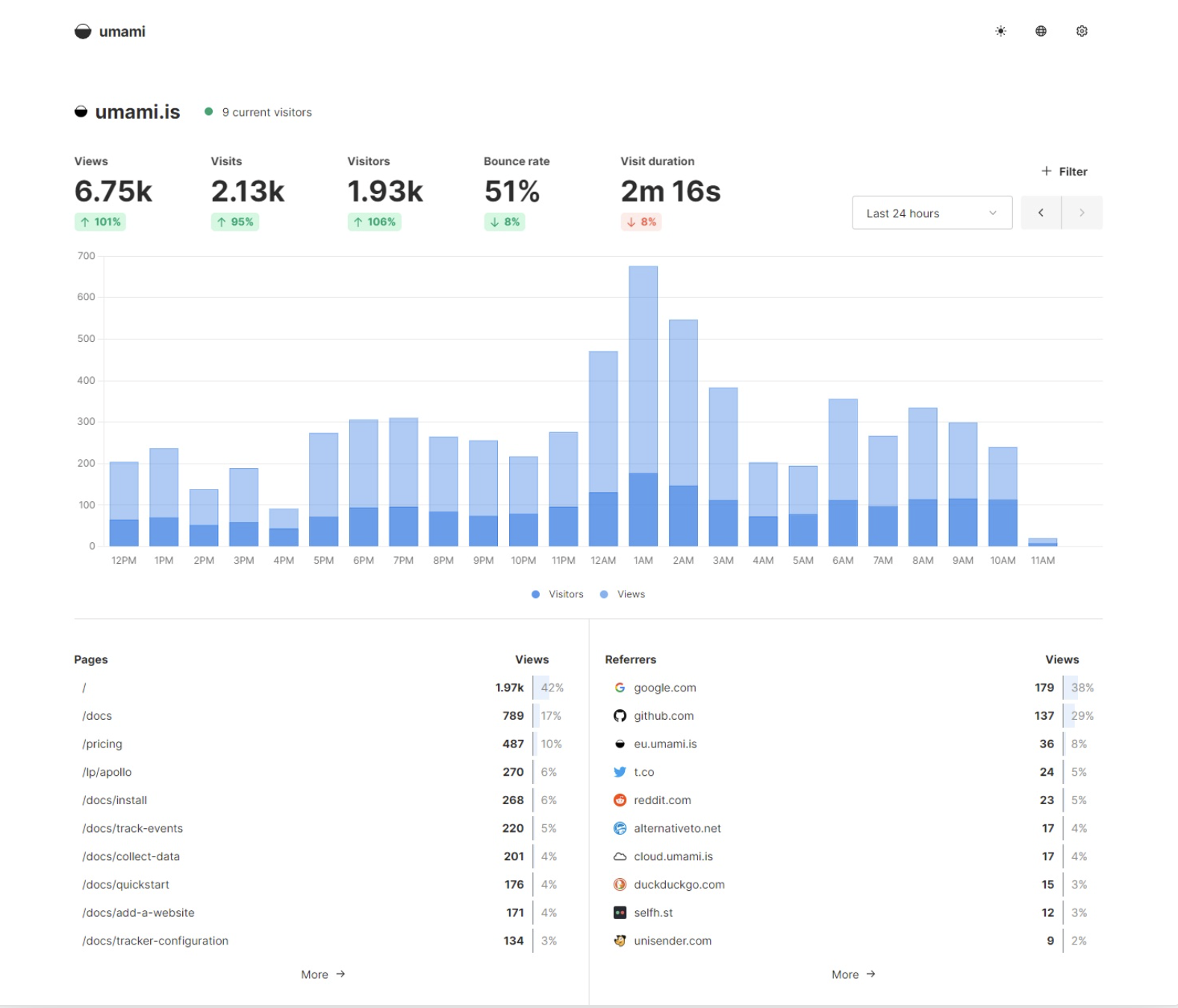
Lightest stack in the privacy-analytics category. Single Postgres container, Node.js, MIT license — no ClickHouse, no Kafka, no premium-plugin upsell. Runs comfortably on a $5/mo VPS or as a side-deploy on Vercel/Railway.
GDPR posture, sub-processors under DPA, per-jurisdiction stance, and encryption — everything a procurement team checks.
?GDPR✓ CompliantEU General Data Protection Regulation
EU's omnibus privacy law requiring a lawful basis for processing personal data (consent, legitimate interest, etc.). Applies to anyone handling EU-resident data. Umami's posture: Legitimate interest. ?CCPA✓ CompliantCalifornia Consumer Privacy Act
California Consumer Privacy Act — rights for California residents (access, deletion, opt-out of sales). Triggered at $25M revenue or 50k+ CA-consumer records. ?UK PECR✕ Not heldUK Privacy and Electronic Communications Regulations
UK Privacy and Electronic Communications Regulations sit on top of GDPR specifically for cookies and electronic marketing. PECR Reg 6 governs analytics-cookie consent. ?SOC 2 · II✕ Not heldSOC 2 Type II
SOC 2 Type II — independent audit verifying security/availability controls operate effectively over 6+ months. Standard B2B procurement requirement. ?ISO 27001✕ Not heldISO/IEC 27001 information-security
ISO/IEC 27001 — international information-security management standard, certified by accredited bodies on a 3-year renewal cycle. ?HIPAA✕ Not heldUS HIPAA (with BAA)
US health-data law requiring a Business Associate Agreement (BAA) for any tool touching protected health information. Without BAA the tool cannot legally process PHI.
Per-jurisdiction posture
🇫🇷
FranceCNILNo banner
Cookieless analytics with no PII fall under CNIL exemption.
?France · CNIL
Cookieless analytics with no PII fall under CNIL exemption. 🇬🇧
United KingdomUK ICO / PECRBanner recommended
PECR Reg 6 likely doesn't trigger (no cookies), but no formal ICO ruling for Umami specifically.
?United Kingdom · UK ICO / PECR
PECR Reg 6 likely doesn't trigger (no cookies), but no formal ICO ruling for Umami specifically. 🇩🇪
ItalyGaranteBanner recommended
Italian Garante is the strictest EU DPA — most analytics use cases trigger consent.
?Italy · Garante
Italian Garante is the strictest EU DPA — most analytics use cases trigger consent.
Sub-processors (6)
GDPR Art. 28 disclosure — third parties under DPA that may receive data.
🇺🇸
Umami Software, Inc
Legal entity (data processor for Cloud customers)
United States
🇺🇸
Vercel Inc
Cloud hosting (Next.js app, edge functions)
United States
🇺🇸
ClickHouse Cloud
Analytics database (US/EU regions)
United States
🇩🇪
Hetzner Online GmbH
EU compute for EU-tier customers
Germany
🇺🇸
Stripe
Payment processing
United States
🇺🇸
Cloudflare
DNS, CDN, DDoS protection
United States
● Collected
URL of page visited
HTTP referrer
User-Agent (parsed to browser/OS)
Country (derived from IP, then IP discarded)
Screen resolution
Custom events (if configured)
● Explicitly NOT collected
IP address (used to derive country, then discarded)
Device fingerprint (no fingerprinting)
Cross-site tracking identifiers
Custom user IDs (unless explicitly sent)
Data retention
Cloud retention varies by plan but is not published on umami.is/pricing — verify in your account or via vendor support. Self-hosted (per umami.is docs FAQ): data retained indefinitely unless you manually delete it.
Encryption
In transit: TLS
At rest: Encrypted at rest (cloud-managed)
DPAYes · manual
✦ AI & Modern Capabilities
How Umami works with AI agents
Tier 3 — no AI yet — vendor focuses on classic privacy-first analytics; no AI/MCP features advertised.
✕AI ChatNot yet
Conversational natural-language interface
Not advertised by vendor
✕MCP ServerNot yet
Model Context Protocol — Claude / Cursor / Codex
Not advertised by vendor
✕Agent APINot yet
Programmatic AI-agent endpoints
Not advertised by vendor
✕AI InsightsNot yet
Anomaly detection / hypothesis / summaries
Not advertised by vendor
✕Export for AINot yet
Structured export formatted for LLM ingestion
Not advertised by vendor
Strengths & weaknesses
What makes Umami worth a look — and where it falls short.
Strengths 8
MIT licensed (most permissive in category)
Lightest stack — Postgres only, no ClickHouse
~2 KB gzipped tracker
Permanent free Hobby tier (100k events)
Cookieless with salted-hash visitor ID
Docker Compose deploy in 15 min
v3.1 ships session replay (rrweb)
Real enterprise users (AMD, Accenture, GM, ESPN, Siemens, Intel, Hulu, VSP)
Weaknesses 6
Default salt rotation = monthly (Plausible: daily)
No GA4 importer — manual cutover
No official WordPress plugin
Cloud on US infra (Vercel + AWS)
No native GSC integration / multi-touch attribution
DNT signal explicitly not honored
Feature matrix
All 38 verified checks across 4 categories. Hover any row for the editor's note.
Tracking & Reporting 15
Pageviews & visitors✓Yes
Live visitor count—No
Top pages report✓Yes
Top referrers✓Yes
UTM campaign tracking✓Yes
Country & city breakdown✓Yes
Device, browser, OS✓Yes
Bounce / engagement✓Yes
Time on site✓Yes
Custom events✓Yes
Goals / conversions✓Yes
Funnels✓Yes
Outbound link tracking✓Yes
File download tracking✓Yes
404 / error tracking—No
Privacy & Compliance 9
Cookieless by default✓Yes
No personal data collected✓Yes
GDPR-compliant out of the box~Partial
Data hosted in EU~Partial
Data hosted in US✓Yes
Self-hostable✓Yes
Open source✓Yes
Data retention periodConfigurable
Bot & spam filtering✓Yes
Setup & Integrations 10
Script weight (KB)2
Single-snippet install✓Yes
WordPress plugin—No
Proxy / first-party domain✓Yes
Public API✓Yes
Data export (CSV/JSON)✓Yes
Google Search Console connector—No
Email digests✓Yes
Slack / webhook alerts—No
Public shareable dashboard✓Yes
Pricing & Plans 4
Free tier exists✓Yes
Entry price ($/mo)$20/mo
Price at 100k pageviews$20/mo
Unlimited sites on entry plan~Partial
Umami vs alternatives
How it compares to the closest 3 rivals on key buyer-decision fields.
Plausible
Privacy-first GA alternative, EU-hosted, simple dashboard
Reviewed by Mark Sutton, cross-checked against vendor documentation. Click any panel to expand.
+What it does well▾
Lightest stack in the privacy-analytics category. Single Postgres container, Node.js, MIT license — no ClickHouse, no Kafka, no premium-plugin upsell. Runs comfortably on a $5/mo VPS or as a side-deploy on Vercel/Railway.
Permanent free tier on Cloud. Hobby = 100k events/mo, 3 sites, no credit card. The most-generous free plan among Cloud-hosted privacy tools.
Genuinely cookieless. No cookies, no localStorage. Visitor identity is a server-side salted hash that rotates (default monthly, configurable). No PII stored.
Surprisingly mainstream customers. AMD, Accenture, GM, ESPN, Siemens, Intel, Hulu — Umami quietly ended up in big-enterprise stacks despite the indie-OSS reputation.
v3.1 added session replay via rrweb. Plausible/Goatcounter still ship without it.
−Weaknesses & gotchas▾
Default monthly salt rotation is looser than peers. Plausible rotates daily; Umami defaults to monthly. That's a longer cross-visit linkability window — change SALT_ROTATION env to day if you care. (The variable exists in source but isn't on the public env-vars docs page yet.)
No GA4 importer. No official tool to backfill historical Google Analytics data. The cutover is a script-swap; you accept losing the past.
No official WordPress plugin. Only the third-party "Integrate Umami" by Ancocodet (~2k installs). Not endorsed by Umami Software.
Cloud is on US-primary infrastructure. Subprocessors: Vercel (US), Cloudflare (US, CDN), ClickHouse (US/EU, analytics DB), Hetzner (EU, secondary). Strict EU-residency teams should self-host.
No funnels in the GA-replacement sense, no heatmaps, no GSC integration. Custom Boards (v3.1) help, but if your job is product analytics, this isn't the tool.
DNT not honored, GPC not honored. Umami's tracker has no built-in Do-Not-Track or Global Privacy Control respect; not mentioned in vendor docs or env vars.
★Best for▾
Best for indie devs, JAMstack/Vercel users, OSS maintainers, side-project builders, and MIT-license maximalists who refuse AGPL (rules out Plausible CE) and want the freest licensing in the category. Self-hosters on tight VPS budgets find it the most affordable path.
Real value comes at the Pro tier ($20/mo) — 1M events/mo, 20 sites, 2-year retention, email reports, 14-day free trial. Hobby tier is great to start but caps fast.
Not for product teams needing funnels/cohorts/retention (use PostHog or OpenPanel), marketing teams needing GSC integration or multi-touch attribution (Plausible/Matomo), or anyone whose primary need is session-replay-first analytics (Matomo wins there).
⚡Setup walkthrough▾
Cloud (managed):
1. Sign up at cloud.umami.is → Hobby plan permanent free, 100k events/mo, 3 sites.
2. Add a website → get a single JS snippet (~2 KB gzipped).
3. Paste it in the of every page.
4. ~5 minutes to first dashboard.
Self-host (Docker Compose):
1. Clone github.com/umami-software/umami.
2. Set DATABASE_URL to a Postgres instance (≥12.14). MySQL is no longer documented in current install path.
3. docker compose up -d ships Umami + Postgres bundled.
4. Set up DNS + TLS via Caddy or nginx reverse proxy.
5. ~15-30 minutes on a fresh VPS. Upgrades: docker pull + restart (~2 min).
6. Set DISABLE_TELEMETRY=1 if you don't want the OSS instance phoning home.
Vercel deploy: community template + Postgres via Neon/Supabase = near-1-click.
↔Migrating from GA4▾
No GA4 importer. Umami doesn't ship one. Migration is a swap-the-snippet exercise.
What you keep: future tracking from cutover day onwards. What you lose: historical GA4 data, Explorations, and any custom dimensions that don't map to Umami's flat model (URL, referrer, browser, country/city, custom event).
Recommended approach:
1. Deploy Umami in parallel for ~30 days.
2. Recreate goal/event names manually in Umami (~10 minutes).
3. Export GA4 data to BigQuery before sunset if you need it preserved.
4. After parallel period, drop the GA4 snippet.
If you live in GA4 Explorations or built attribution flows on UA, expect the floor to drop — Umami's model is intentionally flat.
Help & FAQ
Where to get help with Umami and the questions buyers email us about.
Support
HoursAsync (community-driven)UTC
ChannelsEmail · Github issues · Discord
LanguagesEnglish
Response SLA~48h
FAQ (6)
Is Umami really free?▾
Self-hosted Umami is free under the MIT license — pull the OSS code, run on your own VPS, no fees. Umami Cloud has a free Hobby plan (3 sites, 100k events/mo, 6-month retention) and paid Pro ($20/mo for 1M events) and Business ($200/mo for 10M events) tiers.
What does Umami collect that Plausible doesn't?▾
Umami captures screen resolution by default — small but useful for design teams. Otherwise the tracking model is similar: cookieless, daily-rotating salt hash, no IP storage. Both omit fingerprinting, cross-site IDs, and PII.
How do I self-host Umami?▾
Umami runs as a Next.js app with a PostgreSQL database. Recommended setup: Docker Compose on a 1-2GB VPS. The official docs at umami.is/docs/install cover Vercel one-click, Docker, and bare-metal installs. You'll need ~5-10 minutes for the basic install.
Is Umami GDPR compliant?▾
Yes — for the same reasons Plausible is. Umami doesn't store IP addresses (uses an in-memory hash, discarded daily), doesn't set cookies, and doesn't track visitors across sites. GDPR's legitimate-interest basis applies. Cookie banner is not required under most EU readings (CNIL, UK ICO); Germany TTDSG and Italy Garante are stricter — disclosure is recommended.
Can I import data from Google Analytics into Umami?▾
No native importer. The recommended pattern is parallel installation — run Umami alongside GA4 for 30+ days to build comparable data, then deprecate GA4. Custom dimensions and BigQuery don't migrate cleanly anywhere.
What's the difference between Umami and Plausible?▾
Umami is MIT-licensed (more permissive than Plausible's AGPL), has a permanent free Cloud Hobby tier, captures screen resolution out of the box, and is built on Next.js (vs Plausible's Elixir). Plausible has a longer track record, native funnels on the Business plan, and explicit Looker Studio integration. Both are excellent privacy-first choices.