Middle-of-funnel (MoFu) content—comparison guides, case studies, webinars, “how to choose” pieces—rarely triggers the purchase today. Its value appears days or weeks later, often on a different device and after several touches. That delay makes MoFu the easiest budget to cut and the hardest to defend. This article gives you a rigorous, non-technical playbook to prove its commercial impact without getting into implementation details.
First, define the job MoFu content is hired to do
MoFu content should increase the probability and speed of a qualified conversion by reducing uncertainty. Translate that into four economic levers:
- Reach of qualified audiences (who actually face the problem)
- Propensity shift (higher likelihood to convert later)
- Path efficiency (fewer touches or days to convert)
- Value quality (bigger AOV, higher LTV, better pipeline stage progression)
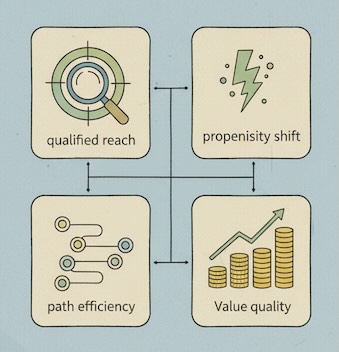
Your ROI narrative will quantify lift across these levers and connect it to revenue or qualified pipeline.
The baseline: what would have happened without the content?
All attribution for MoFu hinges on a credible counterfactual—the path a similar audience would have taken if they had not engaged with the content. You won’t observe that directly, so use structured comparisons:
- Matched cohorts: compare visitors who engaged with MoFu (treatment) to look-alike visitors who did not (control). Match on acquisition channel, geography, device, and first-touch intent.
- Time-lag windows: focus on conversions occurring 2–30 days post-engagement (or your typical consideration cycle), not same-day wins that belong to BoFu.
- Holdouts: keep a portion of similar pages or regions as a standing control to guard against seasonality and market shocks.
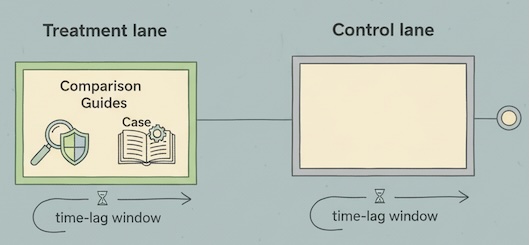
These comparisons set the stage for causal claims instead of thin correlation.
Five attribution lenses that work for MoFu
Use more than one; each illuminates a different part of the story.
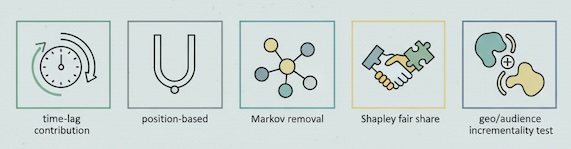
1) Time-lag & path contribution
Measure how often MoFu touches occur before converting sessions and the median days to conversion for paths with vs. without MoFu.
Signals to watch: higher assisted conversion rate, shorter time-to-close, fewer touches per conversion.
Why it matters: MoFu may not steal last-click credit, but it can accelerate the journey—time is money.
2) Position-based (U-shape) with MoFu emphasis
Classic U-shape splits credit between first and last touches, with a slice for the middle. For content-led funnels, increase the middle weight for qualified MoFu interactions (e.g., 50/20/30 → 40/20/40).
Storyline: “When MoFu is present, it consistently contributes X% of credited revenue under position-weighted logic.”
3) Markov chain removal effect
Model the journey as states (channels and content types). Remove MoFu and simulate the drop in conversions (the removal effect).
Outcome: a defensible estimate of conversions that disappear when MoFu pages are absent, even if they never owned last click.
4) Shapley value (cooperative game theory)
Fairly allocates credit by averaging each touchpoint’s marginal contribution across all permutations of the path.
Use case: executive conversations where “fair share” resonates better than “model-dependent” credit.
5) Incrementality tests (geo or audience level)
Temporarily suppress the promotion of MoFu content in comparable markets or audience slices. Track downstream qualified leads or revenue vs. control.
Deliverable: a clean, CFO-friendly lift figure attributable to MoFu exposure.
Turn engagement into economics (without obsessing over vanity metrics)
Engagement alone doesn’t pay salaries. Translate it into propensity and value.
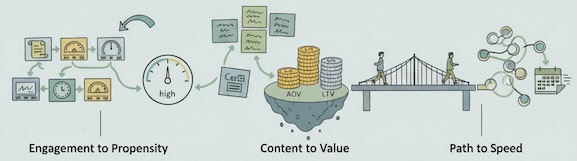
Propensity bridge:
- Build a simple content influence score: (engaged time, scroll depth, repeat visits, content recency) → bin into low/medium/high.
- Compare downstream conversion rate for each bin to the matched control.
- Express the result as uplift: “High-influence readers convert +38% more within 30 days than matched non-readers.”
Value bridge:
- Track AOV/LTV or pipeline stage progression (MQL→SQL→Opportunity) from influenced vs. non-influenced cohorts.
- Present Revenue per Influenced Session (RPIS) or Pipeline per Influenced Session (PPIS) to keep the math simple and shareable.
Path efficiency bridge:
- Show reductions in days to conversion and touches per conversion.
- Quantify the working capital effect: faster cash realization or shorter sales cycles.
The ROI math executives expect
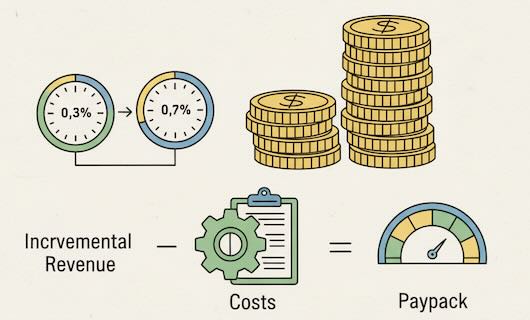
Incremental Conversions (IC):IC = Conversions_treatment – Conversions_control (matched & time-aligned)
Incremental Revenue (IR):IR = IC × Average Value (AOV, LTV, or expected pipeline value × close rate)
Attribution-blended IR (optional):
Use Markov or Shapley for a sanity check: IR_model = Total Revenue × Attributed Share to MoFu
ROI (12-month):(IR – Cost of Content & Distribution) ÷ Cost
Payback period:
Months until cumulative incremental gross margin from MoFu ≥ total cost.
Frame costs broadly—research, writing, editing, design, subject matter expertise, and distribution—so finance signs off on the denominator.
Agencies presenting these numbers to clients also face an internal version of the same problem: proving the people producing this content are working sustainably. Our piece on agency team analytics and employee privacy covers the team-first scorecard that pairs delivery quality and capacity metrics without slipping into surveillance.
Segmentation that explains where MoFu pays off
MoFu value is not uniformly distributed. Slice results to find your power pockets:
- Intent tier: generic problem queries vs. brand+problem vs. solution comparisons
- Industry or use case: e.g., “manufacturing compliance” cohort vs. “SaaS pricing” cohort
- Account tier (B2B): enterprise vs. mid-market vs. SMB
- Product line or AOV band: MoFu usually moves bigger, complex purchases more than low-consideration items
- Device & channel mix: mobile research followed by desktop purchase is a classic MoFu pattern
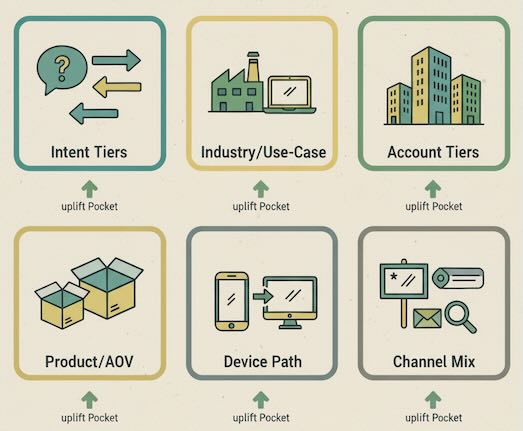
Prioritize future content investment where uplift per influenced session is highest.
Counterfactual stress tests (to keep you honest)
- Seasonality sanity check: Did non-MoFu paths in the same categories improve similarly? If yes, re-estimate the lift.
- Rank and SERP confounds: If organic rankings or paid budgets shifted, report MoFu’s lift at fixed position bands or normalized spend.
- Outlier control: Exclude bursts from limited-time promos and product launches from your core estimate; present them as separate, supportive anecdotes.
- Sustainability: Re-measure quarterly. MoFu lift can decay as competitors copy formats or as product/market awareness shifts.
Case-style illustrations (numbers illustrative)
E-commerce, considered purchase (AOV $180)
- Treatment: visitors who consumed a 1,600-word “How to choose” guide or a product comparison within 14 days pre-purchase
- Control: matched visitors by source, device, and category who did not engage MoFu
- Results (30-day window):
- Conversion rate uplift: +29%
- AOV uplift: +7% (fewer returns, higher bundle attach)
- Touches per conversion: –1.2 on average
- IR (last-click adjusted): $420k / quarter; Payback on content program: < 3 months
B2B SaaS, enterprise pipeline
- Treatment: accounts with ≥2 MoFu interactions (webinar + comparison guide) in the 60 days before opportunity creation
- Control: matched accounts by firmographics and first-touch channel
- Results (90-day window):
- Opportunity creation rate: +22%
- Stage velocity (SQL→Opp): –11 days
- Expected pipeline uplift (modeled close rates): $3.1M / quarter
- Finance note: lift held after controlling for rep assignment and quarter-end effects
Reporting: make it legible for leadership
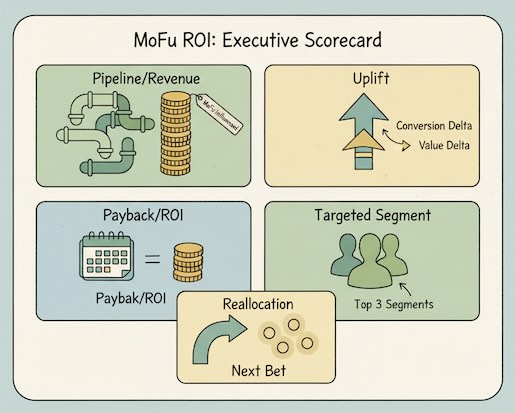
One-slide summary:
- MoFu-influenced pipeline/revenue: $X (quarter)
- Incremental lift vs. matched control: +Y% conversion, +Z% value
- Payback & 12-month ROI: clear, conservative ranges
- Where it works best: top three segments (e.g., enterprise security use case, generic problem queries on mobile, comparison pages for SKUs > $150)
- Next bet: reallocate N% of content budget to proven formats and segments
Appendix for analysts: short method notes (cohort matching, time windows, model cross-checks) so the numbers withstand scrutiny.
The takeaway
MoFu content doesn’t shout “buy now.” It makes buying inevitable—by educating, de-risking, and guiding evaluation. To prove ROI, don’t chase vanity engagement. Anchor your case to propensity, path efficiency, and value quality, supported by counterfactual comparisons and multi-model attribution (time-lag, position-based with MoFu weight, Markov/Shapley, and selective incrementality tests). Present the impact in finance-native terms—incremental conversions, revenue, payback—and double down where uplift per influenced session is highest.
That’s how you defend (and grow) the content budget—without pretending MoFu is a last-click hero.