Privacy-first analytics has gone mainstream. Two names you’ll hear a lot are Plausible and Fathom. Both promise lightweight scripts, cookieless tracking, and GDPR-friendly reporting—without the bloat of legacy tools. This overview compares their capabilities, performance characteristics, and fit so you can choose the right one for your site.
What both tools do well
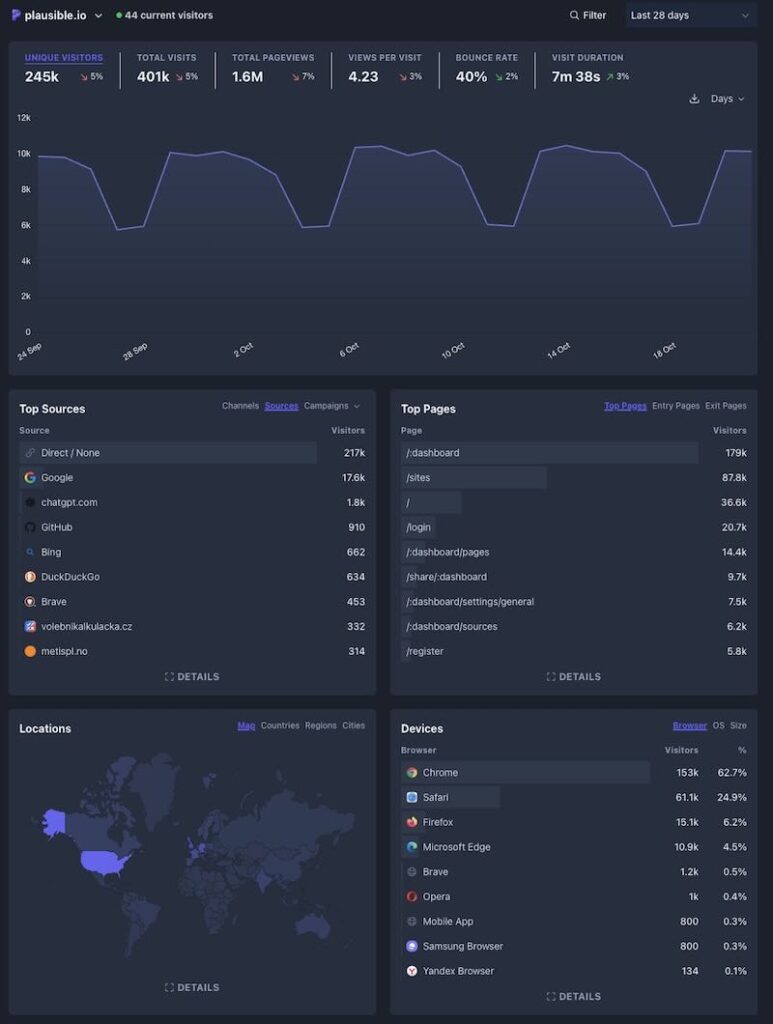
- Privacy by design: cookieless tracking, anonymized IP handling, consent-friendly defaults, GDPR/CCPA/PECR alignment.
- Lightweight scripts: designed to be tiny and fast (single-digit KB gzipped in most setups; verify current sizes in vendor docs before publishing).
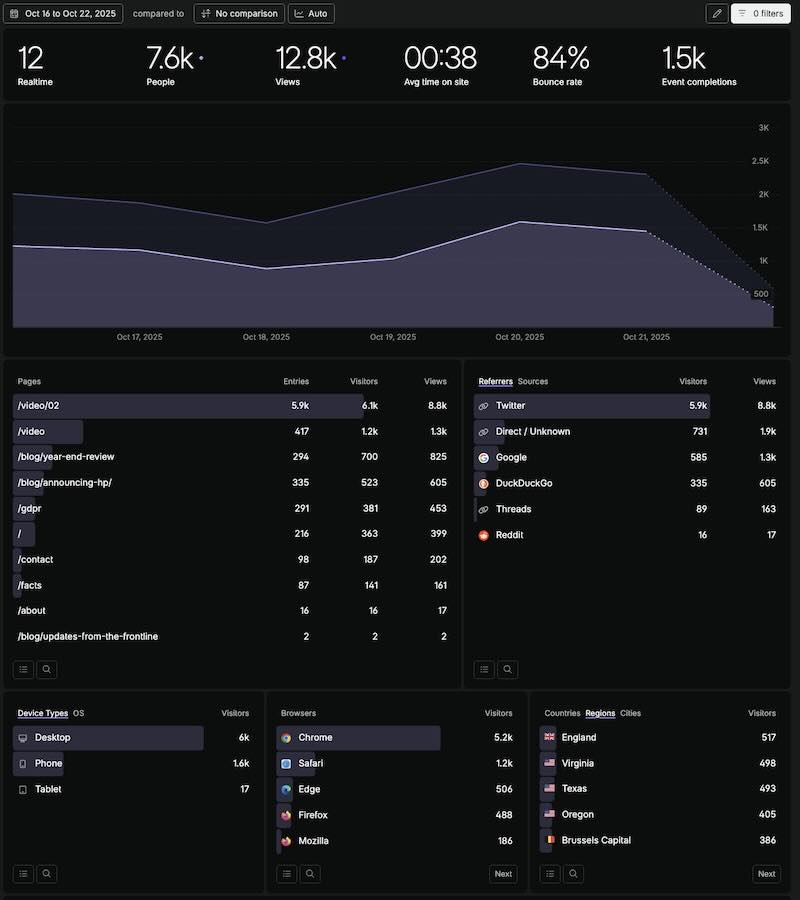
- Essential analytics: pageviews, top content, referrers/UTMs, country/device breakdowns, goals/conversions, basic campaigns.
- Team features: shareable links, email reports, public dashboards (optional), and APIs for exports/BI.
Key differences at a glance
| Feature | Plausible | Fathom Analytics |
|---|---|---|
| Pageviews & visitors |
✓ Pageviews + unique visitors
|
✓ Pageviews + unique visitors
|
| Live visitor count |
✓ Live, ~5s refresh
|
✓ Real-time count
|
| Top pages report |
✓ By pageviews/visitors
|
✓ By pageviews/visitors
|
| Top referrers |
✓ Source domain breakdown
|
✓ Referrer + UTM breakdown
|
| UTM campaign tracking |
✓ Source/medium/campaign breakdown
|
✓ Source/medium/campaign
|
| Custom events |
✓ All paid plans (Starter $9+)
|
✓ fathom.trackEvent() with optional revenue (_value)
|
| Goals / conversions |
✓ All paid plans
|
✓ Events with optional monetary value (revenue tracking)
|
| Cookieless by default |
✓ Daily salt rotates every 24h, then deleted
|
✓ Cookieless: no localStorage/sessionStorage; daily salt rotation (24h UTC) on visitor hash
|
| GDPR-compliant out of the box |
Yes Vendor legal opinion (CNIL-aligned); DE TTDSG/IT Garante stricter
|
True Vendor claims no banner needed (no PII, no terminal storage); legitimate-interest basis
|
| Self-hostable |
✓ MIT, Docker
|
— Cloud-only (no self-host)
|
Use the table below in your internal comparison doc or share it as part of your vendor selection process.
| Capability / Topic | Plausible | Fathom | Notes |
|---|---|---|---|
| Product Model | Open-source core (AGPL) + hosted cloud | Proprietary SaaS (with privacy-first design) | Self-hosting is a major differentiator for Plausible. |
| Setup Simplicity | One-line script; supports custom domains to reduce blocking | One-line script; supports custom domains to reduce blocking | Both are straightforward for non-tech users. |
| Performance Footprint | Very small tracking script; minimal CPU/network overhead | Very small tracking script; minimal CPU/network overhead | Both prioritize speed. Confirm latest script sizes before publishing. |
| Goals & Events | Flexible goals/events; funnels available; segments | Clean goals/events; strong UTM drilldowns | Plausible leans into analytic depth; Fathom emphasizes speed/simplicity. |
| Reporting UI | Content-centric: top pages, paths, conversions, sources | Executive-friendly: clean overview, fast switching across sites | Choose based on who reads reports (content/product vs executives). |
| Ad-block Resilience | Custom domain proxying; server-side options via self-host | Custom domain proxying | Both mitigate blockers ethically. |
| Multi-Site Management | Good; per-site dashboards, shared settings | Excellent for agencies/multi-brand rollups | Fathom’s account structure suits large fleets of sites. |
| Compliance & Data Residency | EU-based company; self-host to control data location | EU Isolation feature; strict privacy posture | Both publish compliance docs—review for your legal needs. |
| Integrations | API, simple dashboards embeds, CMS snippets | API, direct email reports, simple embeds | Both integrate easily into typical stacks. |
| Pricing Approach | Hosted plan by traffic; or no recurring fee if self-host | Hosted plan by traffic; enterprise options | Pricing changes—confirm current tiers before procurement. |
Performance characteristics
Why speed matters: Tracking scripts load on every page and can compound with other assets. Every kilobyte counts for Core Web Vitals and conversion.
- Script weight & requests: Both aim for a single, tiny JS file and a minimal number of beacons.
- Cookieless design: Fewer consent prompts, less storage, fewer JS operations.
- Dashboard responsiveness: Both dashboards are quick; Fathom leans toward ultra-fast overview switching, Plausible offers deeper breakdowns with snappy filters.
- Data sampling: Both tools aim to avoid heavy sampling; check vendor notes if you anticipate very high traffic.
Tip: Whichever tool you pick, proxy the script via a subdomain (e.g., stats.yourdomain.com) to reduce ad-block false positives—consistent with their documentation and your legal guidance.
Strengths & trade-offs
Plausible strengths
- Open-source + self-hosting: choose your infra, your region, your retention.
- Analyst-friendly UI: clearer paths to “which content converts” and goal funneling.
- Transparency: public roadmap, visible codebase.
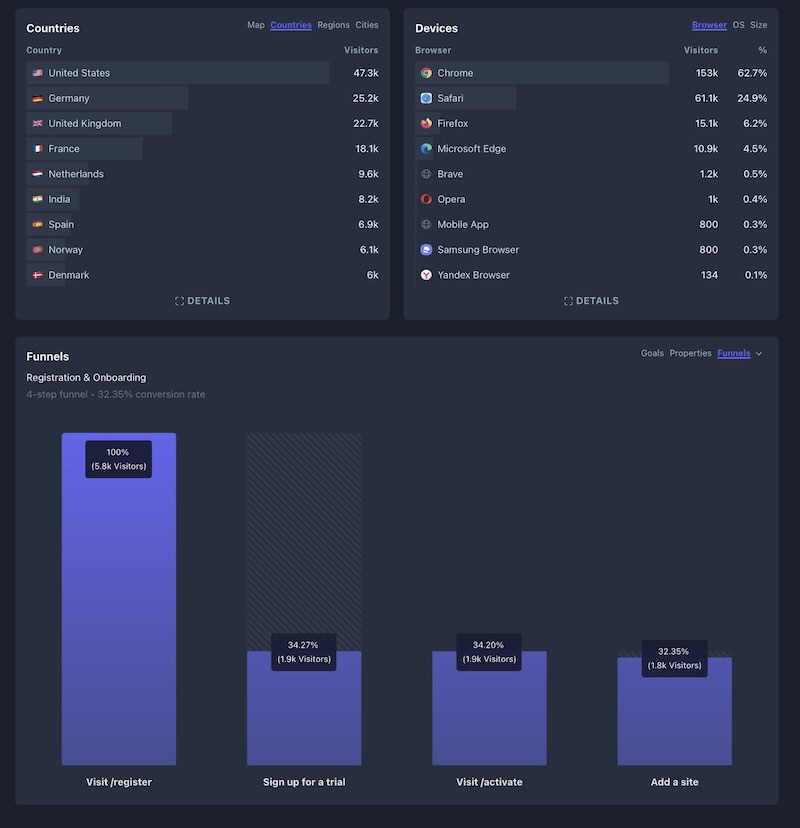
Potential trade-offs
- Slightly more configuration depth can invite “one more report” requests—great for analysts, less ideal if executives want a single clean screen.
Fathom strengths
- Enterprise privacy features: like EU Isolation and hardened defaults.
- Roll-up reporting: particularly convenient for agencies or multi-brand owners.
- Ultra-clean overview: fast checks for leadership.
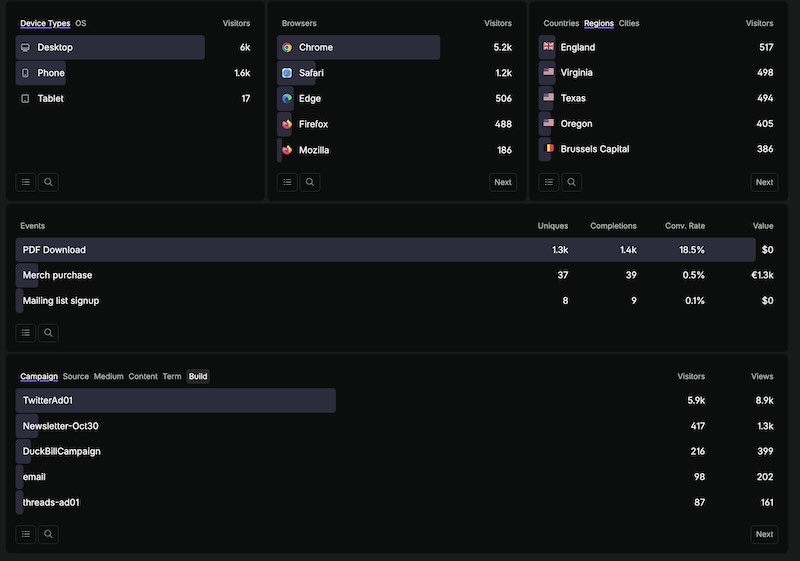
Potential trade-offs
- A bit more opinionated about simplicity; fewer knobs can limit deep slicing for analyst power users.
Which one fits your use case?
- Content-led teams & product marketers → Plausible. You’ll appreciate goal funnels, segmentation, and a dashboard that answers “which pages, which sources, which actions.”
- Agencies, multi-site owners, and privacy-sensitive enterprises → Fathom. Fleet management, compliance posture, and speed-first design are the draw.
- Security/compliance-heavy environments → consider Plausible self-hosting or Fathom EU Isolation, depending on your legal and IT posture.
Comparison table to include in the article
| Area | Plausible | Fathom |
|---|---|---|
| Open-source / Self-host | Yes (AGPL), supported | No (SaaS) |
| Script weight | Very small (verify latest) | Very small (verify latest) |
| Cookies | Not required | Not required |
| Goals & funnels | Robust goals, funnels | Goals, streamlined |
| Multi-site management | Good | Excellent for fleets |
| Data residency | Self-host/EU hosting | EU Isolation option |
| Ad-block mitigation | Custom domain proxy | Custom domain proxy |
| API & exports | Yes | Yes |
| Pricing model | By traffic (or self-host) | By traffic (SaaS) |
Final recommendation
You can’t go wrong with either tool for fast, privacy-first web analytics.
- If your team values depth, transparency, and optional self-hosting, Plausible is a strong default.
- If you manage many properties, need strict data-location assurances, and prefer a clean executive view, Fathom will feel tailor-made.
Before committing, run both in parallel for two weeks: measure dashboard usability for your team, confirm script performance with real Core Web Vitals data, and pressure-test campaign reporting during a live promotion. The better fit will become obvious.