Matomo is the most complete open-source analytics platform you can run, and that’s exactly why people start hunting for a Matomo alternative. The feature list that makes it powerful — heatmaps, A/B testing, a tag manager, ecommerce funnels, custom reports — is also the thing you maintain, patch, and pay for at scale. Somewhere between your first 100,000 pageviews and your first weekend lost to a stuck archiving cron, the question stops being “is Matomo good?” and becomes “is Matomo worth this much tool for what I actually look at?”
I’ve run both Matomo Cloud and self-hosted Matomo across portfolio sites for years, alongside the lighter privacy tools, and the honest answer for most sites is no. You don’t need a Swiss Army knife to read your traffic. So this is not a Matomo takedown — if you want the balanced verdict, read our full Matomo review. This is a guide to the right Matomo alternative for the specific reason you’re leaving, with the one real trade-off named for each.
Why people look for a Matomo alternative
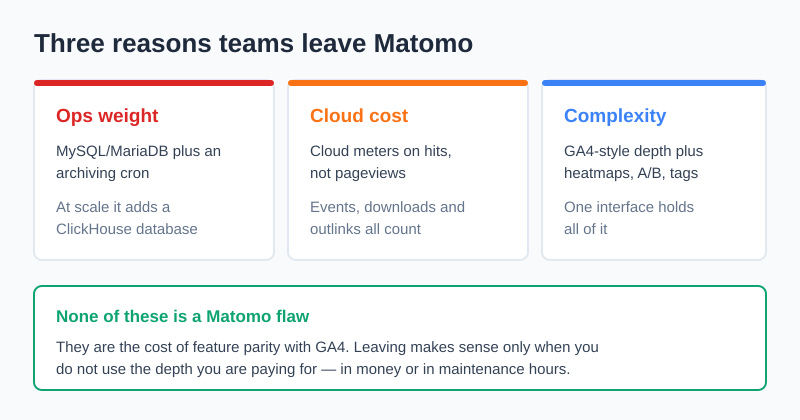
Most people don’t leave Matomo because it’s bad — they leave because it’s heavy for what they need, and that weight shows up in three different bills: ops time, money, and complexity.
Ops weight. Self-hosted Matomo is a PHP application backed by MySQL or MariaDB, and once your traffic grows it leans on an archiving cron that processes report data in the background. Push enough volume and the recommended fix is a ClickHouse column-store on top — a second database to operate, tune, and back up. That’s a real database team’s worth of moving parts for what many sites use as a glorified pageview counter. By contrast, GoatCounter is one binary and Umami is one Node service plus Postgres.
Cost at scale. Matomo Cloud removes the ops burden but meters on “hits” — pageviews plus events, ecommerce actions, downloads, and outlinks. A busy ecommerce site with rich event tracking climbs into the hundreds of euros a month fast, because every tracked interaction counts against the meter, not just pageviews. The lighter tools either count pageviews only or self-host for free.
Complexity. Matomo does everything GA4 does plus everything Hotjar does, in one interface. If you only ever open three reports, the other ninety are friction. Plenty of people escaping Google Analytics simply traded one over-built dashboard for another and want off the treadmill entirely. If you came to Matomo to leave Google Analytics in the first place, the lighter tools below get you the same privacy posture with far less to manage.
Keep in mind what Matomo gives you that you’d be giving up: it’s open source (GPLv3), genuinely self-hosted if you want data residency, and certified GDPR-friendly with a no-banner privacy mode. The good news is that every alternative below matches at least one of those pillars — the trick is matching the right one to your reason for leaving.
How I picked these alternatives
I picked tools I’ve actually run in production, not feature sheets I skimmed. The framework is the same one in our piece on deciding between self-hosted and SaaS analytics: match the tool to the constraint you’re trying to escape, not to the longest feature list.
Each tool here had to clear four bars: it’s privacy-first and cookieless by default (no consent banner needed for basic analytics), it’s either open source or run in the EU under GDPR, it’s materially lighter than Matomo on at least one axis (ops, cost, or interface), and it’s mature enough that I’d put a real site on it. I left out tools that only win on marketing.
One thing I deliberately did not do is rank them 1-to-6 as if there were a single winner. The “best” Matomo alternative depends entirely on why Matomo stopped fitting — so the ranked list below is followed by a decision table that sorts the same tools by your reason for leaving.
The 6 best Matomo alternatives
The short version: Plausible is the closest lighter match, Umami and GoatCounter are the free self-hosted picks, Fathom Analytics is the zero-ops managed option, Piwik PRO is the enterprise route, and Simple Analytics is the no-config one. Here’s each with its single real trade-off against Matomo.
Plausible — closest lightweight match
Verdict: the most natural step down from Matomo if you liked the open-source ethos but not the ops.
Plausible is open source (self-host it or use the hosted cloud), cookieless, GDPR-friendly without a banner, and built around a single roughly-1KB script. The dashboard fits on one screen and still covers goals, custom events, UTM campaigns, and funnels. Hosted plans start at $9/month for up to 10,000 monthly pageviews (plausible.io pricing), and the community edition is free to self-host.
Who it’s for: teams who left Matomo for being heavy but still want to own their data and run their own instance if they choose.
The one trade-off: no heatmaps, no session replay, no A/B testing. If you used those Matomo plugins, Plausible won’t replace them — that’s a deliberate scope decision, not an oversight. See where they diverge in our Matomo vs Plausible side by side.
Umami — open-source, self-hosted, free
Verdict: the developer’s free self-host pick that keeps your stack tiny.
Umami is MIT-licensed (github.com/umami-software) and runs as a single Node.js service backed by PostgreSQL or MySQL — no archiving cron, no ClickHouse, no plugin licenses. Spin it up with Docker in a few minutes and you have unlimited sites, clean event tracking, and a tidy dashboard, all for the cost of the VPS it sits on. There’s a hosted Umami Cloud too if you’d rather not run it.
Who it’s for: developers comfortable with Docker who want Matomo’s “own your data” stance without Matomo’s database footprint.
The one trade-off: reporting depth. Umami covers the core metrics well but doesn’t approach Matomo’s custom reports, segments, or ecommerce reporting. If you want to see exactly how the two compare on resource use and report depth, read Matomo vs Umami.
GoatCounter — the single-binary minimalist
Verdict: the lightest credible option — one binary, one file, done.
GoatCounter ships as a single self-contained binary with an embedded database (SQLite, or PostgreSQL if you prefer). There’s no separate database server to babysit, no cron stack, no plugin marketplace. It’s open source and free to self-host, and the maintainer offers free hosted use for personal sites and small-to-medium businesses (goatcounter.com). It is privacy-first and cookieless by design.
Who it’s for: anyone who found even Matomo’s “lite” footprint too much and wants analytics that runs on the smallest box you own.
The one trade-off: it’s intentionally spartan. You get pageviews, referrers, and basic events — not funnels, not heatmaps, not ecommerce. If your shortlist is between minimalists, the open-source analytics tools hub lays out where each one stops.
Fathom Analytics — managed, zero-ops privacy
Verdict: the closest thing to Matomo Cloud’s “we run it” promise, minus the meter complexity.
Fathom is the managed, no-self-host answer. It’s not open source, but it’s privacy-first, cookieless, GDPR-compliant, and deliberately simple, with EU isolation available. Pricing starts at $45/month for up to 500,000 pageviews (usefathom.com/pricing) — a flat, pageview-based bill rather than Matomo Cloud’s per-hit metering, which makes the cost predictable as event volume grows.
Who it’s for: owners who chose Matomo Cloud to avoid ops, then found the hit-based pricing and feature sprawl more than they wanted.
The one trade-off: you can’t self-host it and you can’t read the source. If “I own and can inspect my data layer” was your reason for choosing Matomo, Fathom asks you to trade that for simplicity.
Piwik PRO — when you need enterprise features
Verdict: the upgrade path, not the downgrade — same Piwik lineage, built for regulated organizations.
Piwik PRO shares its roots with Matomo (both descend from the original Piwik project) and is the option to consider when you’re leaving Matomo because it lacks enterprise governance, not because it’s too heavy. It bundles analytics with a Consent Manager, a Tag Manager, and a Customer Data Platform, with EU/US hosting choices, granular access controls, and HIPAA-capable hosting. Paid Business plans start around €35/month and Enterprise tiers scale into hundreds of millions of monthly actions (piwik.pro/pricing); a limited free Core tier exists for smaller sites.
Who it’s for: compliance, healthcare, finance, and public-sector teams that need consent governance and SLAs baked in.
The one trade-off: it’s heavier and pricier than Matomo, not lighter. This is the right pick only if your reason for leaving is “not enough enterprise controls,” never “too complex.”
Simple Analytics — the no-config option
Verdict: the fastest install on the list — paste a script, never touch a setting.
Simple Analytics is exactly what the name promises: an EU-based, privacy-first, cookieless tool with one dashboard and almost nothing to configure. It’s managed (not open source, not self-hostable), GDPR-compliant by design, and aimed at people who want a single honest number for pageviews and top pages without learning a product. There’s even an automated answer-from-your-data feature for non-analysts.
Who it’s for: founders and writers who never wanted an analytics project and resented every Matomo menu.
The one trade-off: the same as its strength — there’s very little depth. No funnels, no replay, no self-host. It’s the anti-Matomo, and that’s the point.
Pick by your reason for leaving Matomo
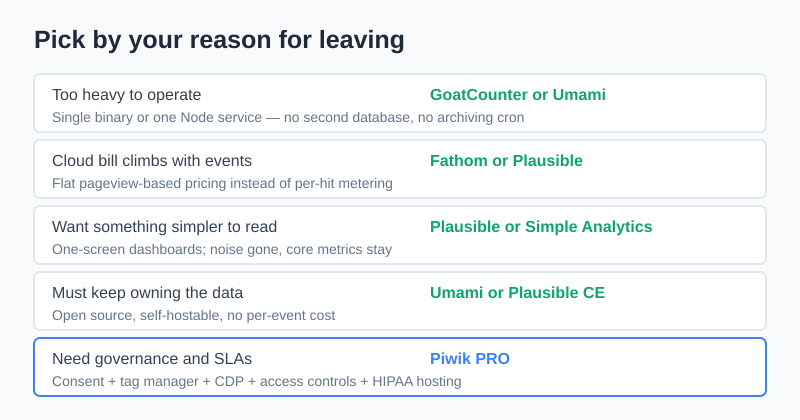
The right alternative is whichever one fixes the specific thing that pushed you out. Find your reason in the left column and start with the pick on the right.
| Your reason for leaving | Start with | Why it fixes it |
|---|---|---|
| Too heavy to operate (ClickHouse, crons, MySQL tuning) | GoatCounter or Umami | Single binary / single Node service — no second database, no archiving cron. |
| Cloud bill keeps climbing with events | Fathom or Plausible | Flat pageview-based pricing instead of per-hit metering. |
| Just want something simpler to read | Plausible or Simple Analytics | One-screen dashboards; the noise is gone, the core metrics stay. |
| Need to keep owning and self-hosting data | Umami or Plausible CE | Open source, self-hostable, no per-event cost. |
| Need enterprise governance and SLAs | Piwik PRO | Consent + tag manager + CDP + access controls + HIPAA hosting. |
Notice that “too heavy” and “need enterprise” point in opposite directions. If you can name your reason in one sentence, the choice almost makes itself — and you avoid the common mistake of swapping Matomo for something equally complex.
Matomo alternatives compared
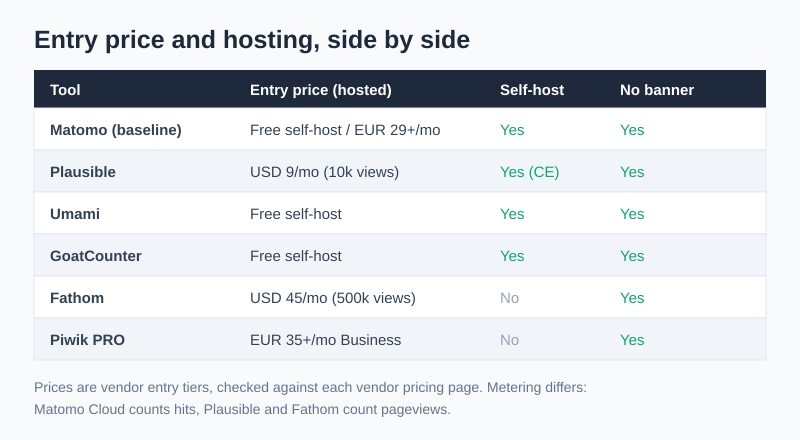
Here’s the same shortlist as a matrix. “Self-host” means you can run it on your own server; “open source” means the code is public and auditable. Prices are entry hosted tiers and self-host options are free unless noted.
| Tool | Open source | Self-host | Entry price (hosted) | Cookieless / no banner | Best for |
|---|---|---|---|---|---|
| Matomo (baseline) | Yes (GPLv3) | Yes | Free self-host / €29+/mo Cloud | Yes (privacy mode) | Feature parity with GA4 + Hotjar |
| Plausible | Yes | Yes (CE) | $9/mo (10k views) | Yes | Closest lighter match |
| Umami | Yes (MIT) | Yes | Free self-host | Yes | Developer self-host |
| GoatCounter | Yes | Yes (single binary) | Free (personal/SMB) | Yes | Absolute minimalist |
| Fathom | No | No | $45/mo (500k views) | Yes | Zero-ops managed |
| Piwik PRO | No | No (managed) | €35+/mo Business (30-day trial) | Yes | Enterprise + compliance |
| Simple Analytics | No | No | Paid (EU-hosted) | Yes | No-config simplicity |
If self-hosting is the whole reason you’re here, the self-hosted analytics options hub goes deeper on resource requirements and backup strategy than this table can. For the wider privacy-first landscape beyond Matomo’s orbit, the open-source analytics tools hub is the better starting point.
FAQ
Why do people look for a Matomo alternative?
People leave Matomo for one of three reasons, and they rarely overlap. The first is ops weight: self-hosted Matomo runs on MySQL or MariaDB with a background archiving cron, and at higher traffic the recommended path adds a ClickHouse database — real infrastructure to operate and back up. The second is cost: Matomo Cloud meters on hits (pageviews plus events, downloads, and outlinks), so an event-rich site’s bill climbs into the hundreds per month. The third is complexity: Matomo packs GA4-style depth plus heatmaps, A/B testing, and a tag manager into one interface, which is overkill if you only read a few reports. If none of those describe you, Matomo is probably still the right tool.
What is the best lightweight alternative to Matomo?
Plausible. It’s the closest like-for-like step down: open source, cookieless, GDPR-friendly without a banner, and self-hostable if you want to keep owning your data — the same instincts that drew you to Matomo, minus the ops and the menu sprawl. Hosted plans start at $9/month for 10,000 pageviews, and the community edition is free to self-host. Its single dashboard still covers goals, custom events, UTM campaigns, and funnels. The trade-off is no heatmaps, session replay, or A/B testing; if you relied on those Matomo plugins, pair Plausible with a dedicated tool or look at Piwik PRO instead.
Is there a free open-source alternative to Matomo?
Yes — several. Umami is MIT-licensed and free to self-host on Node plus PostgreSQL, with no plugin fees. GoatCounter is open source and ships as a single binary you can run for free on a tiny server, and its maintainer also offers free hosted use for personal and small-business sites. Plausible’s community edition is free to self-host as well. All three are cookieless and GDPR-friendly out of the box. The cost in every case is operational rather than licensing — you supply and maintain the server. For sites that want “free and self-hosted” without Matomo’s database footprint, Umami and GoatCounter are the two to compare first.
What is the closest alternative to Matomo for self-hosting?
For pure self-hosting parity, Plausible’s community edition and Umami are the closest matches — both are open source, both run on your own infrastructure, and both keep raw data under your control the way Matomo On-Premise does. The difference is footprint: Matomo carries a large feature surface (and, at scale, a second ClickHouse database), while Umami runs as one Node service and Plausible CE as a compact stack. If you specifically want Matomo’s behavioral depth (heatmaps, A/B testing, ecommerce funnels) on your own server, nothing truly replaces it — that breadth is why Matomo is heavy in the first place. Pick the lighter self-host only if you can give up those plugins.
Are Matomo alternatives GDPR-compliant without a cookie banner?
Most are, by design. Plausible, Umami, GoatCounter, Fathom, and Simple Analytics are all cookieless and don’t track users across sessions, which is what lets them run without a consent banner for basic analytics in the EU. That said, “no banner needed” depends on your exact configuration and any custom events you add, and it’s a stance rather than a blanket legal guarantee — the same caveat applies to Matomo’s own privacy mode. If you’re choosing analytics specifically to drop the consent banner, any of the five managed/open-source picks here gets you there; confirm the specifics for your jurisdiction before you remove it.
Still weighing whether to run it yourself or hand it off? Start with deciding between self-hosted and SaaS analytics, then pick the tool that matches the one reason Matomo stopped fitting.